


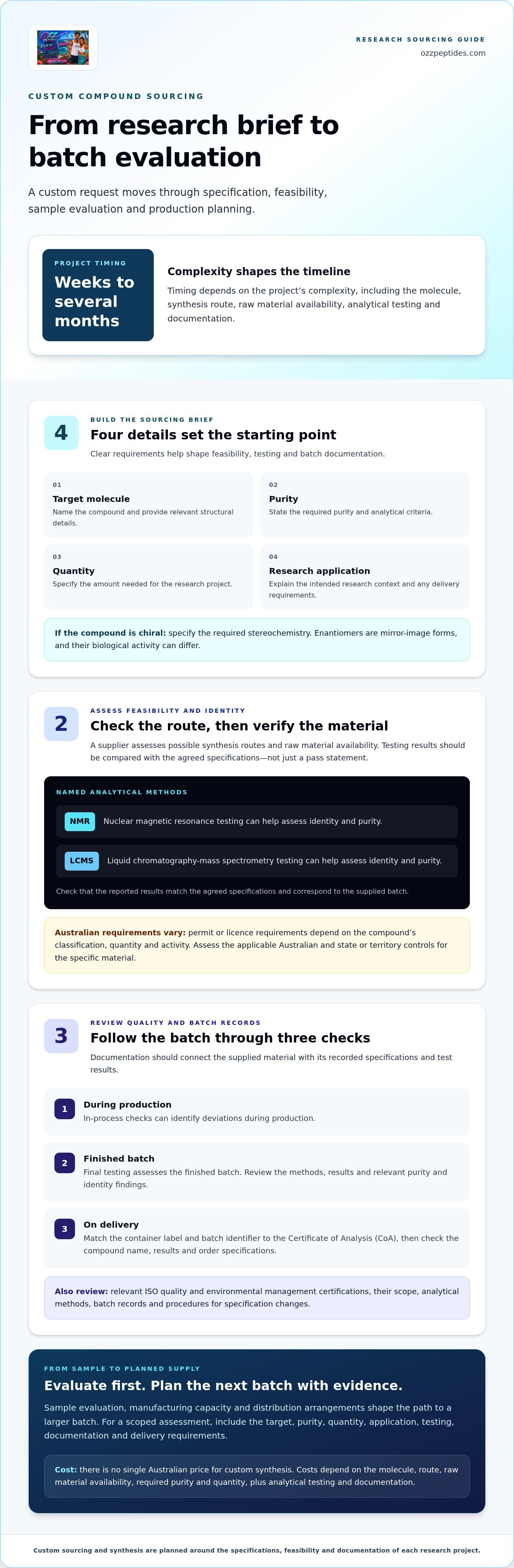
A compound request is only the starting point. Custom laboratory compound sourcing turns a defined research need into a target specification, a feasibility assessment, a sourcing or synthesis plan, and a batch ready for evaluation. Custom projects can take from weeks to several months, depending on their complexity.
That timeline reflects the work involved: confirming the molecule, purity and quantity; assessing synthesis routes and raw material availability; and planning analytical testing and documentation. In pharmaceutical, biotechnology and materials science research, structural details such as stereochemistry can also matter because they may affect a compound’s biological activity.
If you’re considering custom synthesis or trying to source a research compound that isn’t a routine catalogue item, the process can feel complex. This guide explains how to define your requirements, assess feasibility and quality documentation, and plan sample testing, scale-up and supply. It also clarifies when an Australian research supplier can help source existing compounds and reagents.
Key Takeaways
- Define the target molecule, purity, quantity and research application clearly to shape the sourcing brief.
- Assess a supplier’s technical expertise, quality systems, batch testing and documentation before progressing.
- Factor synthesis complexity, raw material availability and sample validation into project planning and timing.
- Understand how manufacturing capacity and distribution arrangements affect the path from a research sample to a larger batch.
Supplier technical expertise and quality systems
Strong technical oversight connects the requested molecular specifications with feasible production and meaningful quality checks. Review the supplier’s analytical methods, batch records and procedures for managing specification changes.
For a practical look at chemists’ work across molecule design and laboratory collaboration, watch this video:
Supplier technical expertise
Technical expertise means translating a research request into workable chemical specifications. A capable team can assess the target molecule, purity, quantity and application, then consider synthesis routes and raw material availability. Look for clear explanations of trade-offs, such as how a purity target affects analytical testing or production planning. For chiral compounds, confirm that the specified stereochemistry is addressed, since it can affect biological activity.
Independent nuclear magnetic resonance (NMR) and liquid chromatography-mass spectrometry (LCMS) testing can help assess identity and purity. Review the methods and results, not just a pass statement. Compare the reported molecular identity and purity with the agreed specifications, and check that the report corresponds to the supplied batch.
Permit or licence requirements depend on the compound’s classification, quantity and the activity involved. Determine the applicable Australian and state or territory controls for the specific material before sourcing it.
Quality management and documentation
Review whether a supplier holds relevant ISO quality and environmental management certifications, and whether its procedures cover purchasing, production, testing and corrective actions. Certification claims should state their scope, so you can see whether the relevant site or activity is covered. Batch documentation should link the supplied material to its recorded specifications and test results.
In-process checks can identify deviations during production, while final testing assesses the finished batch. On delivery, match the container label and batch identifier to its Certificate of Analysis (CoA). Check that the CoA names the compound, reports relevant purity and identity results, and aligns with your order specifications. A CoA is a useful example of batch-level documentation to review.
Custom synthesis for pharmaceutical, biotechnology and materials science research
Custom synthesis starts with a defined research need, then assesses whether a practical synthesis route exists. The workflow connects specifications, feasibility, sample evaluation and production planning.
Custom compound specifications
Specify the target molecule, required purity, quantity and research application. Include structural details, including stereochemistry when the compound is chiral. Enantiomers are mirror-image forms, and their biological activity can differ. State the required form and analytical criteria so the supplier can assess whether the target is achievable.
For pharmaceutical research, stereochemical purity may be central to the study. Biotechnology projects may prioritise a particular molecular structure, while materials science work may require properties suited to a defined application. Clear specifications give the feasibility assessment a firm starting point and help shape batch documentation.
Synthesis cost considerations
There is no single Australian price for custom compound synthesis. Projected costs depend on the target molecule, synthesis route, raw material availability, required purity and quantity. Additional analytical testing and documentation also affect the work involved.
A supplier’s feasibility assessment weighs these factors before production planning. A complex molecule with a demanding purity specification can require a different workflow from a straightforward target. Request a scoped assessment that identifies the proposed route, testing requirements and cost assumptions, so the project scope can be compared with your research needs.
Australian synthesis and sourcing suppliers
Australian researchers can engage custom synthesis specialists or compound-sourcing suppliers that coordinate synthesis through external chemistry services. The right fit depends on the required molecule, quantity, technical capabilities and how much workflow coordination the project needs.
Some research organisations manage route design while outsourcing synthetic work. For example, the Yale Center for Molecular Discovery may design the route and manage a contractor’s synthesis. For an Australian project, establish who handles route feasibility, production updates, sample evaluation and final documentation. For existing research compounds, browse the research compound catalogue as a separate sourcing option.
Manufacturing, delivery and distribution
Production planning links an evaluated sample to the final target quantity. Manufacturing, analytical checks and delivery arrangements all shape the workflow.
Import and sourcing regulations
Australian requirements depend on the compound’s classification, intended use and whether it is imported or sourced domestically. Those details determine which controls apply.
Before arranging supply, identify the exact material and its intended research application, then assess the relevant Australian requirements for that compound and supply pathway. Hazard information also informs handling, storage and transport arrangements. Don’t assume that a research label alone determines a compound’s regulatory status.
Quote request process
To request a quote, provide the target molecule, required purity, quantity and research application. Include analytical testing, documentation and delivery requirements so the proposed scope reflects the full workflow.
A supplier can then assess synthesis routes, raw material availability and projected costs. Share any constraints that affect production or distribution, such as a required delivery destination or sample evaluation stage. A clear brief helps establish what work is included and which factors shape the estimate.
Manufacturing can take from weeks to several months, depending on project complexity. Sample batches allow researchers to evaluate materials before scale-up. This step can show whether a sample meets the target specifications before committing to larger production quantities.
Production capacity may range from gram-scale laboratory quantities to metric-ton commercial volumes. The appropriate scale depends on the project’s requirements, the synthesis route and the supplier’s capabilities. Analytical testing during production and on the finished batch supports consistency with agreed specifications.
Custom sourcing also involves practical risks. Confidentiality agreements and restricted data access can help protect proprietary formulations and processes. Hazard information guides safe handling, while manufacturing complexity, raw material availability and distribution arrangements can affect delivery timing. Agree on the sample review point, documentation and shipping responsibilities as part of the project workflow.
Which Australian suppliers offer custom synthesis and compound sourcing?
Australian research teams can work with custom synthesis specialists, contract chemistry services or compound-sourcing suppliers. These providers handle different parts of a project, from route design and production to locating an existing research material. Match the supplier type to the target molecule and the work your laboratory needs completed.
A custom synthesis specialist focuses on making a specified molecule. A contract chemistry service may carry out synthesis designed or managed by the research organisation. A compound-sourcing supplier can coordinate access to laboratory compounds and research reagents. These models differ in who leads the chemistry, who manages production and what batch documentation accompanies the material.
Map the project workflow before choosing a route. For a new molecule, define the target structure and required specifications, then identify whether the work needs route feasibility, sample production, analytical testing or scale-up. For an existing compound, focus on identity, batch records and supply arrangements. A clear scope helps distinguish synthesis from sourcing.
Assess each supplier against the project’s actual requirements. Consider technical capabilities, communication across production stages, confidentiality arrangements and the documentation supplied with the batch. For example, a project involving a proprietary formulation may need confidentiality terms, while a study comparing batches needs traceable identifiers and analytical results. The relevant priorities depend on the application.
Australian researchers seeking laboratory materials can also use a domestic research supplier when the requirement is an available compound rather than a newly synthesised molecule. That route suits catalogue sourcing; it doesn’t replace a custom synthesis project with molecule-specific production. Keep the distinction clear when defining the brief and expected deliverables.
Use the project scope to choose the appropriate pathway: custom synthesis for a target molecule, or direct sourcing for an existing research compound. A concise brief should identify the application, specifications, quantities, testing needs and delivery requirements. These details help establish whether the request involves synthesis, sourcing or both.
OZZ Peptides: Research Peptides
OZZ Peptides supplies Research Peptides, Research Reagents, Laboratory Research Compounds and Research-Grade Peptides for scientific and laboratory research. It supports researchers across Australia with local customer care and fast Australia-wide delivery using Australia Post Express Post.
Choose this route when your project needs an available research compound rather than a newly synthesised molecule. OZZ Peptides supplies compounds with third-party Certificates of Analysis, giving researchers batch documentation to review alongside their specifications. These products are for research purposes only, not human consumption or medical treatment.
For a defined custom target, use the sourcing steps in this guide to prepare your specifications and assess the project pathway. For existing research materials, explore the research compound range.
Visit ozzpeptides.com to explore the research range or get in touch with OZZ Peptides.
Turn your research brief into a practical next step
The next step is to match your project’s needs with the right sourcing pathway. Decide whether your work calls for a newly synthesised target or an existing laboratory material, then keep the research purpose and required specifications at the centre of your planning. Clear decisions early can help your team organise procurement around the work ahead.
For Australian researchers sourcing existing materials, OZZ Peptides offers Research Peptides, Research Reagents and Laboratory Research Compounds. Its range supports laboratory research, while custom laboratory compound sourcing is a separate route for projects that need a specific molecule made to defined requirements. Products are for research purposes only, not human consumption or medical treatment.
Choose the option that fits your study, then visit OZZ Peptides to explore its research range.
Frequently Asked Questions
What does custom laboratory compound sourcing involve?
Custom laboratory compound sourcing coordinates the identification or synthesis of a research compound to meet a defined project need. For example, a laboratory might need a non-standard molecule or an existing compound in a particular form. The sourcing brief should distinguish between finding an available material and commissioning new synthesis. Include structural identifiers where available, the intended research application and any handling or delivery constraints.
What are typical lead times for custom laboratory compounds?
Custom projects can take from weeks to several months, depending on complexity. An existing compound may follow a different schedule from a new synthesis requiring route development, sample production and validation. Raw material availability, analytical testing and review stages can all affect the project timeline. Map these milestones against your study schedule, including time to assess a sample before planned experiments.
How do Australian suppliers compare on purity, analytical testing and certificates of analysis?
Compare the batch evidence, not just a headline purity claim. Check whether analytical results identify the supplied batch and cover the measurements relevant to your work. Methods such as NMR and LCMS can provide different information about identity and composition. A Certificate of Analysis is most useful when its compound name, batch identifier, test results and reported purity align with the material received.
What quality assurance and supplier credentials should laboratories check?
Review quality-system credentials alongside documented procedures for production, testing and handling deviations. Check the scope of any ISO quality or environmental management certification and whether it applies to the relevant site or activity. GMP compliance may also be relevant to the project. Ask how batch records link specifications, in-process checks and final analytical results, then compare that evidence with your laboratory’s requirements.
Disclaimer
Research Information Disclaimer
The information provided in this article is intended solely for general educational and scientific research purposes.
OZZ Peptides supplies laboratory research compounds and reagents for legitimate research applications only. Products labelled for research use are not intended for human or veterinary consumption, injection, diagnosis, treatment or prevention of disease.
Information about experimental compounds, scientific studies or preliminary research findings should not be interpreted as medical advice or evidence of regulatory approval.
Scientific findings may be preliminary, and research outcomes are not guaranteed.
Readers should consult appropriately qualified professionals and applicable Australian regulatory guidance before undertaking relevant research activities.