

How to Check a Research Peptide COA

Could a peptide COA show impressive purity and still leave key questions unanswered? It can. A purity result alone doesn’t confirm that the document matches the batch you received or establish the compound’s identity. Knowing how to check peptide COA details helps you assess the evidence instead of relying on one headline figure.
Start by matching the material name and batch number, then check the sample information and testing laboratory. Next, review what the reported methods can show and where their limits are. A consistent review makes it easier to spot mismatches or missing information before relying on the document in research.
This guide explains the checks in plain English, including the difference between identity testing and purity analysis, and which records to keep with your research documentation. OZZ Peptides supplies research-grade compounds with independent third-party Certificates of Analysis (COAs) to support batch review. All compounds are intended strictly for scientific and laboratory research.
Key Takeaways
- When checking peptide COA details, match the material name and batch or lot number to the product documentation.
- Check who issued the report and whether it identifies the methods, results and scope of testing.
- Read HPLC and mass spectrometry findings as evidence with specific limits, not as proof of every quality attribute.
- Record the COA version, batch identifier and any unresolved questions with your research records.
How to check a peptide COA: what the document can and cannot show
A Certificate of Analysis (COA) reports specified tests and results for identified material, often linked to a particular batch. It provides evidence to review, not a blanket assurance. A COA doesn’t prove every quality attribute or predict a research outcome. The general purpose of a Certificate of Analysis (COA) is to record test findings for the material described.
A COA can establish only what its reported tests measured for the material identified in the report. The document’s presence alone isn’t enough. Its material description and identifiers need to connect clearly to the product under review. OZZ Peptides’ COA library gives researchers product documentation to review alongside their records.
What questions can a peptide COA help answer?
Identity and purity are separate questions. A reported identity method, such as mass spectrometry, may support whether the detected material is consistent with the stated compound. A purity result describes the analysis reported for the sample. By itself, it doesn’t confirm identity. Review each result alongside its method and stated scope.
Other properties, such as water content or residual solvents, are supported only when the COA reports relevant tests and results. If a property isn’t addressed, the document provides no evidence about it.
What a COA cannot establish on its own
A COA can’t guarantee that a compound is suitable for every research purpose or experimental condition. Study design, handling and other variables matter, and a laboratory report doesn’t establish research performance.
Don’t treat a high purity percentage as proof of identity, safety or suitability. It reflects the reported analysis, not every possible attribute of the material. For laboratory research, use the COA as one part of a documented review and keep its limits in view.
Check the peptide COA against the product and batch
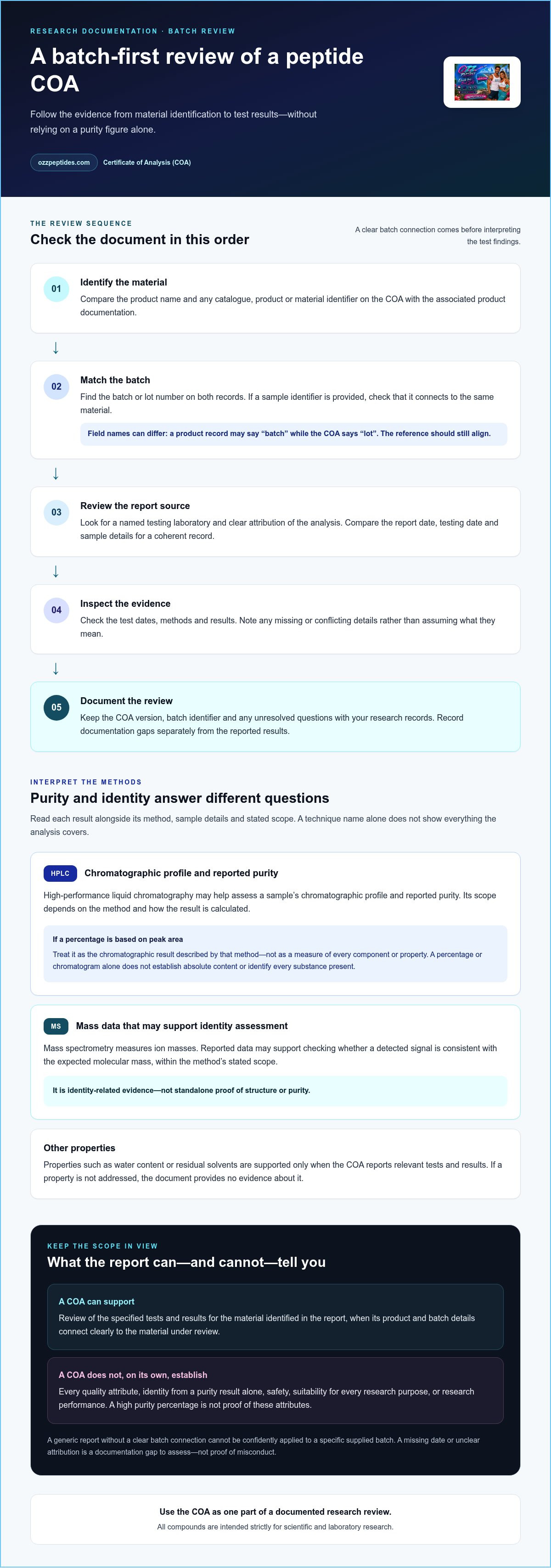
Use a consistent order: confirm the product, match its batch, assess who issued the report, then examine the test evidence. This batch-first approach helps you decide whether the COA applies to the material in front of you, rather than to a similar product.
- Identify the material. Compare the product name and any catalogue, product or material identifier on the COA with the associated product documentation.
- Match the batch. Find the batch or lot number on both records. Check that the sample identifier, where provided, connects to the same material.
- Review the source. Look for a named testing laboratory and clear attribution of the report to it.
- Inspect the evidence. Check the test dates, methods and results. Note any missing or conflicting details.
Which identifiers should match?
Labels vary, so compare the information rather than expecting identical field names. A batch number on the product record might be labelled “lot” on the COA. The product name and identifier should still point to the same material, and the batch or lot reference should align. A generic report without a clear batch connection can’t be confidently applied to a specific supplied batch. For more on research peptide purity and documentation, keep the report’s stated scope in view.
How to assess the report source
Check that the laboratory is named and that the document clearly attributes the analysis to it. Compare the report date, testing date and sample details for a coherent record. A missing date or unclear attribution is a documentation gap to record and assess, not proof of misconduct. Keep such gaps separate from the reported test results.
Batch-specific documentation is one part of responsible research sourcing. OZZ Peptides’ research compounds range includes product documentation for researchers to review.
Interpret HPLC and mass spectrometry results without overreading them
HPLC and mass spectrometry answer different questions. Read the method, sample details and stated result together. A technique name alone doesn’t tell you the full scope of the analysis.
HPLC (high-performance liquid chromatography): May help assess the sample’s chromatographic profile and reported purity. Its scope depends on the method and how the result is calculated.
Mass spectrometry (MS): Measures ion masses that may support an identity assessment. Interpretation depends on the reported data and method. It isn’t complete proof on its own.
Other tests, if reported: May address additional properties, but only for the specific measurements and scope stated in the report.
Purity and identity are separate questions, and they need different supporting evidence. Keeping that distinction clear helps you avoid reading more into COA results than the report shows.
What does an HPLC purity result tell you?
A reported HPLC purity percentage describes the result of the specified analysis. Review the method and, if provided, the chromatogram, which displays detector signals as peaks over time. These details help explain what was separated and how the reported figure was derived. If the result is reported as a percentage of peak area, treat it as the chromatographic result described by that method, not as a measure of every component or property of the sample. A percentage or chromatogram alone doesn’t establish absolute content or identify every substance present.
What does mass spectrometry add?
Mass spectrometry can provide mass data that supports checking whether a detected signal is consistent with the expected molecular mass. Treat it as identity-related evidence within the report’s stated scope, not as a standalone guarantee of structure or purity. When reading a peptide Certificate of Analysis, consider how each result relates to the question you’re assessing.
Use methods as evidence, not as shorthand for overall quality. Research compounds are intended strictly for scientific and laboratory research.
Use a peptide COA checklist to document your review
A short written record makes it easier to connect a COA to the material and understand what evidence you relied on. Use the same review steps for each report and keep the COA with relevant research records. This makes your review repeatable rather than dependent on a single result.
What should your review record include?
Capture enough detail for another researcher to trace your review later. Record the report’s title and version or date, the material and batch identifier, and the date you reviewed it. Then note what the document actually reports.
- Document match: Product or material name, identifier and batch or lot reference.
- Source: Named laboratory and how the report attributes the testing.
- Evidence: Reported methods, results and any stated acceptance criteria.
- Limits: Missing fields, unclear scope, discrepancies or unresolved questions.
Describe gaps plainly. For example, write “sample identifier not shown” rather than assuming the result applies to a particular batch. Keep a copy of the report you reviewed so you can compare its details with your notes later.
When is the COA review complete?
Your review is complete when the product identifiers align and the reported evidence addresses the question relevant to your research. That doesn’t make the COA conclusive for every quality attribute or experimental condition. If a key detail remains unclear, record the limitation and don’t treat an unstated result as established.
OZZ Peptides’ Certificates of Analysis library provides product documentation for review. Research compounds are intended strictly for scientific and laboratory research, not human consumption, injection or treatment. Compare the relevant COA with your product records and save both together for reference.
Make COA review part of your research workflow
A useful review process isn’t a one-off exercise. Build it into how your team receives and documents research materials, so each decision has a clear record that can be revisited if questions arise. Knowing how to check peptide COA documentation gives researchers a consistent starting point while leaving room to assess each report on its own terms.
Keep review notes with the related research records and use them to inform material selection. OZZ Peptides supplies research-grade compounds intended strictly for scientific and laboratory research.
With an evidence-led approach, documentation review can become a straightforward part of responsible research. Take it one report at a time.
Frequently Asked Questions
Is a peptide COA enough to confirm a product's identity?
Not necessarily. Look for more than a method name: check whether the report presents an observed result and compares it with the stated material. If it gives only a test label without interpretable findings, note that the identity evidence is limited. Keep the laboratory’s wording in your records rather than turning it into a stronger claim.
Can a peptide COA prove the material is suitable for every research application?
No. Suitability depends on the requirements of the specific study. Identify the attributes your protocol requires and check whether the COA reports relevant results. If your study sets an acceptance criterion for a property the report doesn’t assess, record it as an unanswered requirement rather than assuming it has been met.
How do I know whether a peptide COA matches my batch?
Check every character of the batch or lot code, including prefixes and suffixes. Don’t assume a shortened or reformatted identifier refers to the same batch. If the COA and product paperwork use different codes, preserve both versions and record the discrepancy as written. This creates a clear record without silently changing the identifier.
What does HPLC purity on a peptide COA mean?
Before comparing purity figures from separate reports, check whether they use comparable methods and reporting conventions. Differences in sample preparation, chromatographic conditions or calculation can affect how results are presented. A percentage from one report may not be directly comparable with a figure elsewhere. Record the method details with the result rather than comparing percentages in isolation.
Does a third-party COA guarantee a peptide's quality?
No. “Third-party” describes who performed the testing, not automatically the laboratory’s accreditation or the scope of its competence. If a report claims accreditation, note the standard and whether the relevant test falls within the stated scope. Keep that information distinct from the analytical result itself. A laboratory’s status doesn’t extend what the report actually tested.
To review batch documentation alongside research-grade compounds, explore the OZZ Peptides research range. All compounds are intended strictly for scientific and laboratory research.
Disclaimer
Research Information Disclaimer
The information provided in this article is intended solely for general educational and scientific research purposes.
OZZ Peptides supplies laboratory research compounds and reagents for legitimate research applications only. Products labelled for research use are not intended for human or veterinary consumption, injection, diagnosis, treatment or prevention of disease.
Information about experimental compounds, scientific studies or preliminary research findings should not be interpreted as medical advice or evidence of regulatory approval.
Scientific findings may be preliminary, and research outcomes are not guaranteed.
Readers should consult appropriately qualified professionals and applicable Australian regulatory guidance before undertaking relevant research activities.