

How to Read a Peptide Certificate of Analysis

A high purity figure can look like a clear answer, but it doesn’t tell the whole story. A peptide certificate of analysis is useful when you can connect its results to the supplied research batch and understand what was tested. Treat the headline percentage as one piece of evidence, not a blanket guarantee.
If HPLC, mass spectrometry, chromatograms or lot numbers are unfamiliar, this guide explains the main COA fields in plain English. You’ll learn how to match a report to a batch and what purity results can and can’t establish.
Use the test methods, laboratory details and report dates to put results in context, without reading more into them than the document supports. OZZ Peptides provides a COA resource for accessing available product documentation. All compounds discussed are for laboratory research only, not human consumption or injection.
Key Takeaways
- Use a peptide certificate of analysis to review documented test results, not to predict research outcomes.
- Read purity figures alongside the test method and other report details. One percentage doesn’t establish every quality attribute.
- Match the report’s product identifier and batch or lot reference to the supplied material. Record any mismatch as unresolved.
- Keep batch documentation with relevant study records, then assess its relevance against your research protocol and methods.
What does a peptide certificate of analysis tell you?
A peptide certificate of analysis (COA) records analytical information about a tested sample or batch. A product description tells you how a product is presented; a COA documents test-related details and findings for identified material. It helps you review those results, but it doesn’t predict how a compound will perform in a research experiment.
COA layouts and test panels vary. A report may identify the material and batch, describe the analytical methods used, and present results. The Certificate of Analysis Wikipedia overview offers general background, but each report needs to be interpreted on its own terms.
This short video offers another introduction to reading a peptide COA:
Why do research laboratories use a peptide COA?
A COA gives laboratory staff a record to file with the material’s identifying details. Keeping it alongside batch and study records supports traceability, making it easier to identify the report associated with the material used in a particular piece of work. OZZ Peptides provides an online COA resource for available product documentation.
A COA is one part of a careful workflow, not a substitute for a research protocol. It documents results from specified analyses, but doesn’t establish that a compound suits every research design, method or study condition. Assess that fit against your own protocol. Products discussed here are for scientific and laboratory research only, not for human consumption or injection.
How to interpret peptide COA results without overreading them
Read each result in light of the method and the question it was designed to answer. A peptide certificate of analysis may report several analytical findings, but no single figure tells you everything about a sample. A purity result, for example, describes the outcome of a particular analysis, not every quality attribute.
A purity result alone does not establish full identity or suitability for a particular research protocol. Treat the report as evidence to assess, not as a guarantee.
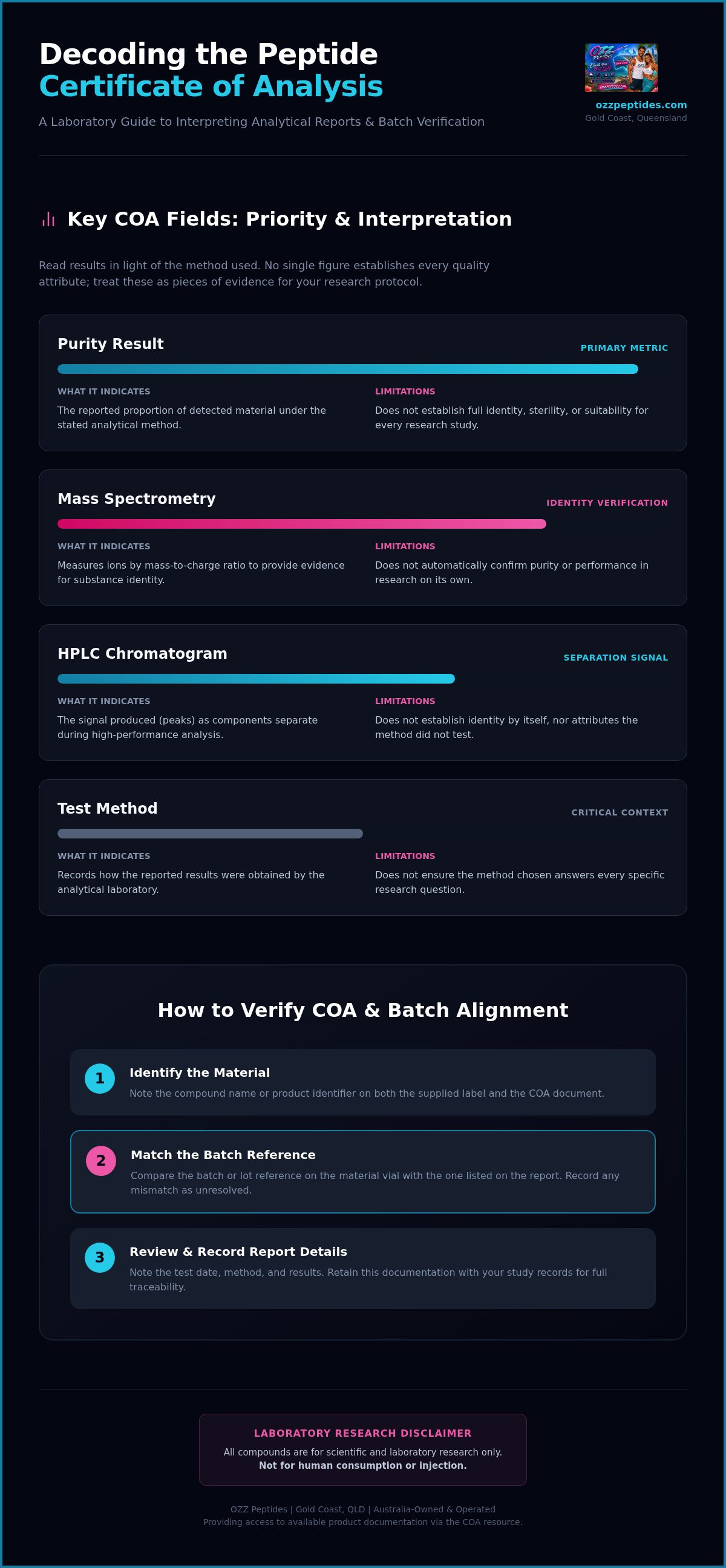
| Field | What it can indicate | What it cannot establish |
|---|---|---|
| Purity result | The reported proportion of detected material under the stated method | Full identity, sterility or suitability for every study |
| HPLC chromatogram | The signal produced as components separate during analysis | Identity by itself, or attributes the method did not test |
| Mass spectrometry | Mass-related evidence that can support identity assessment | Purity, sterility or research performance on its own |
| Test method | How the reported result was obtained | That the method answers every research question |
What do HPLC results and chromatograms show?
High-performance liquid chromatography (HPLC) separates components in a sample. A chromatogram displays the resulting signal, often as peaks across a run. A reported purity figure may be calculated from that signal, but its meaning depends on the method and how the result is presented. Read the method and result together rather than treating a peak or percentage as a complete quality verdict.
What can identity testing establish?
Mass spectrometry measures ions by their mass-to-charge ratio and can provide evidence relevant to a substance’s identity. If a COA includes this test, interpret the result in the context of the stated method. It doesn’t automatically confirm purity or other properties. For broader regulatory context on documentation for active pharmaceutical ingredients, see the FDA Guidance on Certificates of Analysis.
To review documented testing alongside available research materials, browse research compounds. Products are for laboratory research only, not human consumption or injection.
How to check that a peptide COA matches the research batch
A peptide certificate of analysis is relevant to your material only when you can link the report to the supplied batch. Compare the identifiers, then keep the document with your laboratory records. This creates a traceable connection between the material and the analytical results reported for it.
Which details should you compare first?
Start with the product name or identifier, then compare the batch or lot reference on the supplied material with the one on the report. Note the testing date, analytical method and reported result where these details appear. Formatting can vary, so focus on whether the identifiers clearly point to the same material and batch.
- Identify the material. Note the compound name or product identifier on the supplied label and COA.
- Match the batch. Compare the batch or lot reference on both. If they differ, record the mismatch as unresolved.
- Review the report details. Note the test date, method and result when stated, and retain them with the batch record.
What if a field is missing or unclear?
A missing date or unclear identifier limits what you can conclude from the document. It isn’t, by itself, proof that the supplied material is defective. Record the uncertainty rather than filling the gap with an assumption, and follow your laboratory’s established quality procedures for incomplete or mismatched documentation. OZZ Peptides’ COA resource provides access to available product documentation.
Keep a copy of the report with the material’s batch details and relevant study records. If the identifiers don’t align, don’t record the match as confirmed. Products are for scientific and laboratory research only, not for human consumption or injection.
How to use a peptide COA in a responsible research workflow
Make the report part of the study record, not a stand-alone quality decision. Save the COA with the material’s product identifier, batch or lot reference, receipt details and relevant study documentation. This helps show which batch was associated with the work and makes the information easier to review later.
Researchers remain responsible for assessing whether the material and documented results suit their own protocol, analytical methods and experimental model. A COA can inform that assessment, but it doesn’t replace laboratory procedures or establish that a compound will produce a particular result.
Where can Australian researchers find supporting documentation?
OZZ Peptides provides available peptide Certificates of Analysis as product documentation. Keep the COA with your batch records and use it alongside your laboratory’s own procedures. OZZ Peptides supplies research compounds for laboratory studies only, not for human use, consumption or injection.
What should your COA review not replace?
Keep the report distinct from your laboratory’s protocol, method validation and quality-control requirements. A documented analytical result doesn’t establish clinical efficacy, safety for people or suitability for every experimental model. Use it as one record in a carefully documented research workflow, and apply established procedures when deciding whether material is appropriate for a specific study.
Keep the research-use boundary clear: these compounds are for scientific and laboratory research, not human consumption or injection. To review available product documentation and research compounds, visit the COA resource or browse the research catalogue.
Build a clear record for your next study
Make documentation part of your research process from the outset. Save the peptide certificate of analysis alongside batch details and study records, then apply your laboratory’s own criteria before using the material in a research protocol. This makes later reviews more orderly and keeps decisions tied to the records available at the time.
OZZ Peptides supplies research-grade compounds for scientific and laboratory research, supported by independent third-party Certificates of Analysis. These materials are for laboratory research only, not for human consumption or injection.
For your next project, review the available documentation and explore OZZ Peptides’ research range. Keep a clear protocol, careful records and a considered assessment of the supporting information.
Frequently Asked Questions
What does a peptide certificate of analysis show?
A peptide certificate of analysis shows the analytical information recorded for the material named in the document. Check whether the report states acceptance criteria alongside its results. If it does, note whether each value is presented against a stated limit. Don’t assume an unstated threshold or apply one from a different report.
Is HPLC purity the same as peptide identity?
No. A purity result and an identity assessment answer different questions. Check how the report defines its purity calculation. For example, a chromatographic area percentage shouldn’t automatically be read as a percentage by mass. This matters when comparing documents that report results in different ways. Keep the measurement basis clear in any comparison or summary.
How do I match a peptide COA to its batch?
Use the batch reference to link the physical material with its supporting document. If your laboratory assigns its own sample code, record it alongside the supplier’s batch reference so the connection remains clear after aliquoting or transferring material. Keep the original report unchanged, and use a separate note for internal identifiers or handling details.
Does a third-party peptide COA prove a compound is suitable for every experiment?
No. A COA can’t validate a laboratory’s experimental design. An analytical result, for example, doesn’t establish that the material will behave as expected in a particular assay or sample matrix. Before a study, consider whether the available documentation addresses the questions your protocol depends on, and document any assumptions that remain outside the report’s scope.
What should I do if a peptide COA does not show a test method?
Don’t treat the result as fully interpretable without understanding its analytical basis. In your review notes, identify the result affected and state what information is absent, rather than applying a method name from another document. Keep the note with your assessment so a later reviewer can distinguish a reporting gap from information that was considered and resolved.
Disclaimer
Research Information Disclaimer
The information provided in this article is intended solely for general educational and scientific research purposes.
OZZ Peptides supplies laboratory research compounds and reagents for legitimate research applications only. Products labelled for research use are not intended for human or veterinary consumption, injection, diagnosis, treatment or prevention of disease.
Information about experimental compounds, scientific studies or preliminary research findings should not be interpreted as medical advice or evidence of regulatory approval.
Scientific findings may be preliminary, and research outcomes are not guaranteed.
Readers should consult appropriately qualified professionals and applicable Australian regulatory guidance before undertaking relevant research activities.