

Research Peptide Purity and Documentation

What does a 99% purity result tell you if the report doesn’t name the test method or connect the result to the batch you received? A percentage can look definitive, but research peptide purity documentation is only useful when you understand what was tested and what the result can show.
It’s reasonable to expect a Certificate of Analysis (COA) to clarify both purity and identity. These are different kinds of evidence: a purity result describes the measured composition under a stated method, while an identity result helps assess whether the material matches the expected peptide. Neither should be treated as proof of every quality attribute.
This guide explains how to read common report details, what HPLC and mass spectrometry can indicate, and which identifiers help link a report to a research batch. You’ll also learn how to make a cautious, documented assessment of COA limitations. OZZ Peptides supplies research-grade peptides with independent third-party Certificates of Analysis. All compounds discussed are for laboratory research only, not human consumption or injection.
Key Takeaways
- Use research peptide purity documentation to understand what a reported result measures, not as a guarantee of every quality attribute.
- Compare HPLC and mass spectrometry details to see what each method can indicate and where its evidence ends.
- Match the compound and batch identifiers across the COA, product documentation and label where available.
- Keep the COA with the relevant batch record, noting when you reviewed it and any limitations that remain.
What does research peptide purity documentation tell you?
Research peptide purity documentation records analytical findings for a sample. It can help you assess what a test detected, but it doesn’t guarantee every quality attribute of the material. A purity result is a method-dependent estimate of the target material relative to the other components detected under the stated test conditions.
A purity percentage is meaningful only alongside the method, the sample tested and the report’s context. That context matters because peptide production can involve purification steps, and results depend on what the analytical method can detect. The overview of peptide synthesis describes why purification is part of producing peptides.
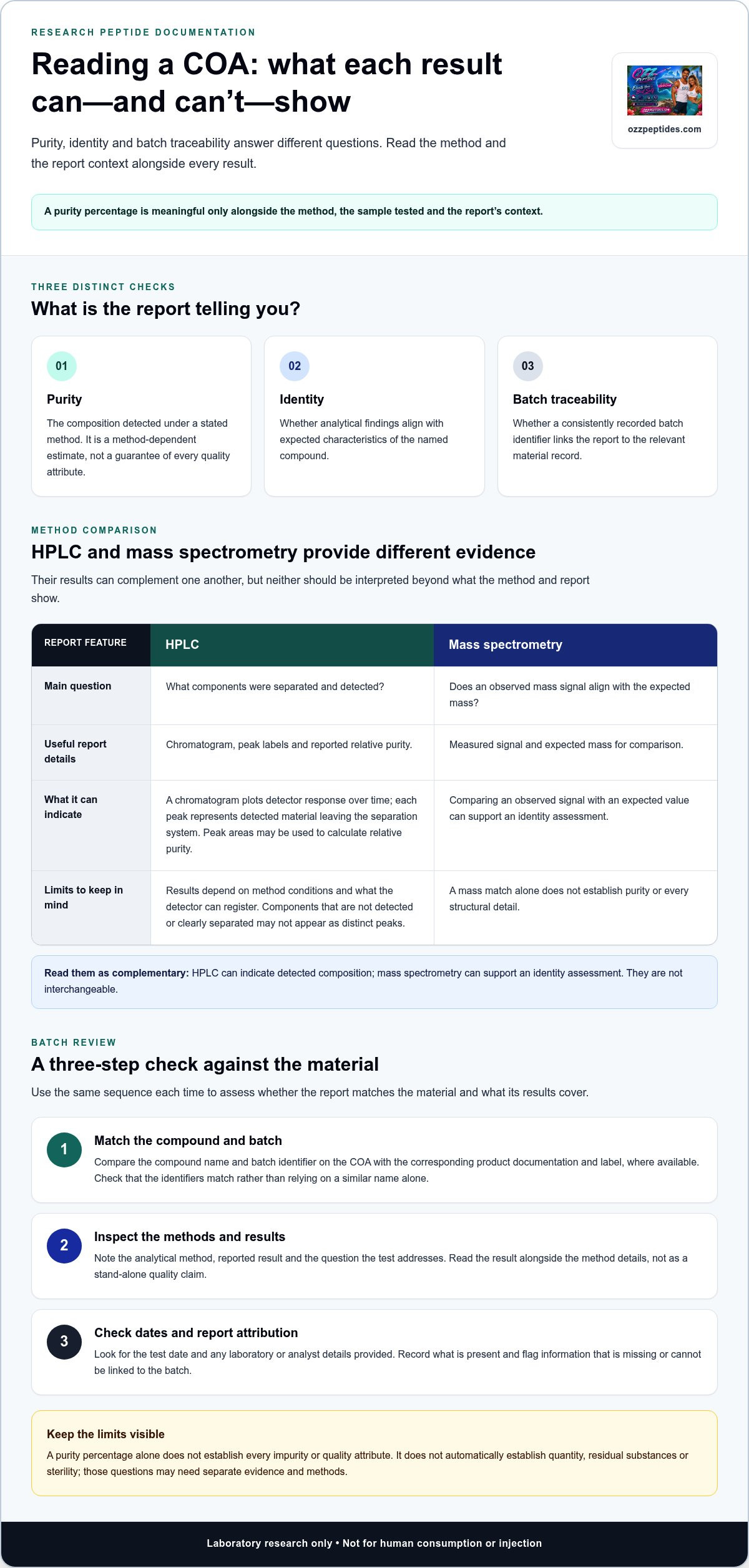
Purity, identity and batch traceability: three different questions
These terms describe separate pieces of evidence. Purity concerns the composition detected by a stated method. Identity asks whether analytical findings align with expected characteristics of the named compound. Batch traceability links a report to a particular material record through a consistently recorded batch identifier.
A report might provide a purity result without showing identity evidence, or include identity findings without answering every question about composition. Likewise, a batch code only supports traceability if it matches the relevant product documentation and label. The available Certificates of Analysis offer records that readers can examine while applying these distinctions.
What a purity percentage does not establish
A reported percentage doesn’t automatically describe every impurity or quality attribute. Some components may not be detected or resolved by the method used, and the figure alone doesn’t establish attributes such as quantity, residual substances or sterility. Those questions may need separate evidence and methods.
There’s no single percentage that answers every research question. Interpretation depends on the method, how results are reported, the sample and the requirements of the research context. Read the value with its supporting details, not as a stand-alone guarantee. These distinctions help keep a COA useful without asking it to prove more than it reports.
How do HPLC and mass spectrometry support peptide purity documentation?
HPLC and mass spectrometry answer different analytical questions. HPLC separates components detected in a sample, while mass spectrometry records mass-to-charge signals that can be compared with the compound’s expected mass. Together, their results can provide complementary evidence, but neither should be read beyond what the method and report show.
Purity and identity are distinct analytical questions: HPLC can indicate the detected composition, while mass spectrometry can support an identity assessment.
| Method | Question addressed | Useful report details | Limits |
|---|---|---|---|
| HPLC | What components were separated and detected? | Chromatogram, peak labels and reported relative purity | Results depend on method conditions and what the detector can register. |
| Mass spectrometry | Does an observed mass signal align with the expected mass? | Measured signal and expected mass for comparison | A mass match alone doesn’t establish purity or every structural detail. |
What can an HPLC chromatogram show?
A chromatogram plots detector response over time. Each peak represents material detected as it leaves the separation system. A report may calculate relative purity from peak areas, but that figure is not automatically an absolute measure of everything in the sample. Components the method doesn’t detect or separate clearly may not be reflected as distinct peaks. Check the method description and how the result is labelled.
Why read mass spectrometry alongside a purity result?
Mass spectrometry measures signals according to mass-to-charge ratio. Comparing an observed signal with an expected value can support an identity assessment. It doesn’t show, by itself, how much of the sample is the target peptide or resolve every possible structural difference. Read the two results as complementary, not interchangeable.
For research peptide purity documentation, note the method and reported result together when reviewing a record. OZZ Peptides’ research compound catalogue is a practical next step for laboratory research.
How can you review a research peptide COA against its batch?
Use a consistent sequence to check whether the report matches the material and what its results actually cover. This makes research peptide purity documentation easier to assess and gives you a clear record of any unanswered questions.
- Match the compound and batch. Compare the compound name and batch identifier on the COA with the corresponding product documentation and label, where available. Make sure the identifiers match, rather than relying on a similar name alone.
- Inspect the methods and results. Note the analytical method, reported result and what question the test addresses. Check that the result is labelled clearly and read it alongside the method details, not as a stand-alone quality claim.
- Check dates and report attribution. Look for the test date and any laboratory or analyst details provided. Record which details are present, and flag information that’s missing or can’t be linked to the batch.
Which COA fields should you cross-check?
Start with the compound name, batch identifier, method, result and test date. Then note any laboratory or analyst attribution shown on the report. OZZ Peptides’ available Certificates of Analysis can be reviewed alongside the matching product documentation. If a field is absent, write that down rather than filling the gap with an assumption.
When does a document leave important questions open?
A generic report without a matching batch identifier offers less evidence that its findings relate to the material in hand. An undated record also leaves the timing of the analysis unclear. These gaps limit traceability, but they don’t, by themselves, establish misconduct. Likewise, don’t assume a COA covers sterility, endotoxins or another attribute unless that test and its result are stated.
For a practical record, keep the COA with the relevant batch documentation and note your review date and any unresolved gaps. That way, another researcher can see what was checked and what remains uncertain.
How should Australian research teams use purity documentation responsibly?
Build a record that makes your team’s review clear to someone who wasn’t involved in the original assessment. Keep the report with the relevant research documentation, note when it was reviewed and make any unresolved limitations easy to find.
Build a clear record without overstating the evidence
Use a short note to explain how the analytical findings inform your research record. Keep conclusions limited to the reported results, and clearly distinguish documented observations from assumptions or unanswered questions.
- File the report with the relevant research records.
- Note the review date and any limitations that matter to interpretation.
- Keep conclusions within the scope of the evidence provided.
Documentation supports laboratory research recordkeeping. It doesn’t establish therapeutic benefit, medical approval or suitability for human use. Research compounds are for laboratory research only, not human consumption or injection. For wider context, the Australian research peptides guide covers related research considerations.
Where can researchers find relevant OZZ Peptides documentation?
After considering how documentation informs your research records, browse the research peptide catalogue as a relevant next step for laboratory research.
Make documentation part of your next research workflow
Make your review process repeatable. A consistent approach helps your team carry useful context forward as research records grow, instead of relying on someone to remember why a result was interpreted a certain way. Treat research peptide purity documentation as one part of that workflow, with conclusions matched to the evidence available.
Keep the next step focused on your laboratory research needs and the documentation relevant to them.
Explore Our Research Range
Thoughtful records make a stronger starting point for the work ahead.
Frequently Asked Questions
What does peptide purity mean on a Certificate of Analysis?
Peptide purity on a COA is a result calculated from the sample’s detected components using the stated analytical method. It isn’t a universal measure that can automatically be compared with a result from another method. For example, two reports showing the same percentage may differ in how the samples were analysed or how results were calculated. Read the method and reporting basis alongside the figure.
Does HPLC confirm a peptide’s identity?
HPLC alone doesn’t conclusively confirm a peptide’s identity. It separates components and records when they appear, which can support comparison with a reference under the same conditions. But a similar retention time isn’t enough on its own to establish identity. Check whether the COA includes separate identity evidence, such as a mass spectrometry result, and note precisely which findings the report provides.
Can mass spectrometry prove peptide purity?
No. Mass spectrometry can support an identity assessment by comparing observed mass signals with an expected value, but it doesn’t independently establish the sample’s purity. A signal’s strength isn’t automatically a direct measure of how much peptide is present, since measurement depends on the analytical setup and sample response. In research peptide purity documentation, read mass results alongside a method that assesses sample composition.
How do you check whether a peptide COA matches the batch?
Compare the COA’s compound name and batch identifier with the label and associated product record. Check the full identifier, including any letters or suffixes, rather than assuming similar codes refer to the same batch. If a code is missing or differs, record the discrepancy and leave the match unresolved until the paperwork clearly links the report to that material.
Does a high peptide purity result mean a research compound is safe for human use?
No. A high purity result doesn’t establish safety, a suitable human-use dose, medical approval or therapeutic benefit. It describes only what the specified analytical test reports about its sample. OZZ Peptides supplies research compounds for scientific and laboratory research only, not human consumption or injection. Keep purity findings within that research context and don’t use a COA as a basis for human use.
Disclaimer
Research Information Disclaimer
The information provided in this article is intended solely for general educational and scientific research purposes.
OZZ Peptides supplies laboratory research compounds and reagents for legitimate research applications only. Products labelled for research use are not intended for human or veterinary consumption, injection, diagnosis, treatment or prevention of disease.
Information about experimental compounds, scientific studies or preliminary research findings should not be interpreted as medical advice or evidence of regulatory approval.
Scientific findings may be preliminary, and research outcomes are not guaranteed.
Readers should consult appropriately qualified professionals and applicable Australian regulatory guidance before undertaking relevant research activities.