


Could “peptide reagent” mean the peptide being studied, or a chemical reagent used to make one? Search results often place these categories side by side, making peptide reagents for research harder to identify than they should be.
That confusion is understandable. Both relate to peptide work, but they serve different roles. A peptide research compound is the material under investigation; peptide synthesis reagents support the chemical steps used to assemble or modify peptide chains. Knowing the difference helps researchers match catalogue descriptions to their laboratory question, rather than assume every product labelled “peptide” serves the same purpose.
This guide explains the roles of peptide research compounds and synthesis reagents, outlines common laboratory contexts without overstating early findings, and covers the product details and batch documentation that can inform sourcing. It also draws a clear boundary: these products are for scientific and laboratory research only, not human consumption, injection or treatment. OZZ Peptides is an Australian-owned supplier of research-grade peptides and laboratory compounds, with third-party Certificates of Analysis available to support product and batch review.
Key Takeaways
- Match peptide reagents for research to the experimental question: a peptide compound and a peptide synthesis reagent serve different laboratory roles.
- Consider whether a material is suitable as a control, standard or assay-related study material for your method.
- Review product identity and batch documentation; a Certificate of Analysis reports analytical information, not experimental performance or guaranteed results.
- Australian researchers can explore OZZ Peptides’ research materials, nationwide Express Post and custom sourcing for non-standard requirements.
What does peptide reagents for research mean?
“Peptide reagents for research” can refer to peptide compounds studied in a laboratory or to chemicals used to synthesise peptides. The phrase alone doesn’t identify which category a researcher needs. Check the product description and intended laboratory task before interpreting a catalogue result.
A peptide research reagent is a laboratory material used in an investigation involving peptides, either as the peptide being studied or as an input in peptide synthesis. The term describes a research role, not a particular experimental outcome.
Peptide compounds and peptide synthesis reagents: what is the difference?
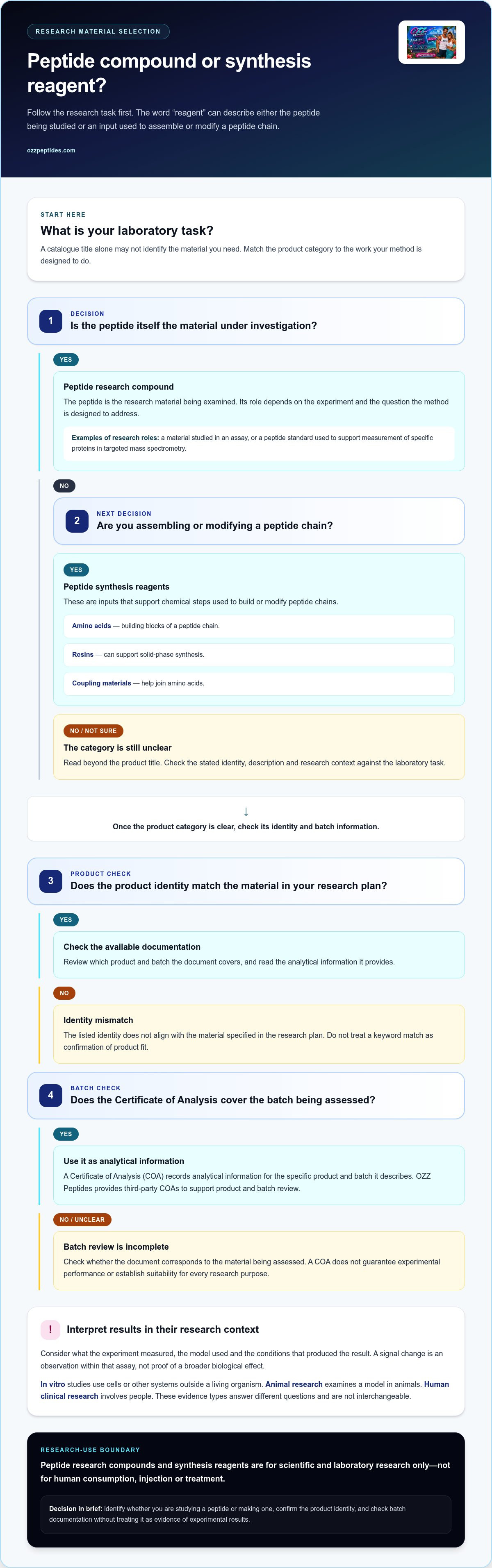
A peptide compound may be the research material under investigation. By contrast, synthesis inputs help build a peptide chain: amino acids are its building blocks, resins can support solid-phase synthesis, and coupling materials help join amino acids. These are distinct product categories, even if search listings group them together. The Peptide synthesis overview explains chemical and solid-phase approaches in more detail.
Why the distinction matters when reading research results
Start with the task. A study examining a peptide compound calls for the compound under investigation; a project making a peptide calls for synthesis inputs and a suitable method. A “standard” is a reference material used for comparison or measurement, while a “control” provides a comparison condition in an experiment. Neither term means a product will produce a particular result.
Search results can blur these meanings because “reagent” is used broadly for materials used in laboratory work. Read beyond the title: look for the product’s stated identity, description and research context. For a plain-English overview of research-grade peptide materials, OZZ Peptides supplies research compounds for scientific and laboratory research only. This distinction helps keep product selection tied to the actual experimental question, rather than a keyword match.
How are peptide reagents used in laboratory research?
Researchers select peptide materials according to the measurement or biological question their method is designed to address. In an assay, a peptide may help examine a defined interaction or contribute to measuring a target. The method determines what the resulting signal means. A signal change, for example, is an observation within that assay, not proof of a broader biological effect.
Research context shapes how peptide findings should be interpreted: a result applies first to the model, conditions and measurement used to produce it. In vitro studies use cells or other systems outside a living organism; animal research examines a model in animals; human clinical research involves people. These evidence types answer different questions and should not be treated as interchangeable.
What can peptide compounds help researchers investigate?
In targeted mass spectrometry, researchers can use peptide standards to support measurement of specific proteins. Carr and colleagues discuss best practices for developing mass spectrometry-based assays in Molecular & Cellular Proteomics. This is an analytical application: it concerns measuring proteins, not establishing that a peptide has a treatment effect. The assay’s design and validation shape what its results can show.
How does the experimental method shape interpretation?
Before drawing a conclusion, consider what the experiment measured, which model it used and whether the result is consistent across appropriate replicates. A finding in cultured cells may help frame a later research question, but it doesn’t establish the same effect in an animal or a person. Published results need to be read alongside their methods and limitations. Researchers can explore OZZ Peptides’ research peptides and laboratory compounds for scientific and laboratory research only.
How can researchers assess peptide reagents and their documentation?
Use a consistent review before selecting peptide reagents for research. Start with the experiment, then check what the product is and what its documentation can establish. This keeps a catalogue description from being mistaken for evidence that a material suits every method.
- Define the research purpose. Identify the question and the role the material needs to play.
- Confirm product identity. Compare the product name and description with the material specified in your research plan.
- Review available documentation. Check which product and batch the document covers, and read the analytical information it provides.
- Assess experimental fit. Consider whether the identity and documentation align with your established protocol and method.
What can a Certificate of Analysis tell you?
A Certificate of Analysis (COA) records analytical information for the specific product and batch it describes. Read the document alongside the product details, and make sure the batch information corresponds to the material being assessed. OZZ Peptides provides third-party Certificates of Analysis to support product and batch review; its Certificates of Analysis page provides access to this documentation. A COA doesn’t show how a material will perform in your experiment, guarantee a result or establish suitability for every research purpose.
Match the reagent to the research question
Documentation is one part of the decision, not a substitute for the research protocol. Check that the product identity fits the material your method calls for, and interpret any analytical information within that context. Purity is one consideration, but it doesn’t alone establish experimental suitability. Broader sourcing decisions also depend on the research requirements and product context.
Where can Australian researchers source peptide research materials?
Australian researchers can source peptide reagents for research from OZZ Peptides, an Australian-owned supplier of research-grade peptides, reagents and laboratory compounds. Products are supplied for scientific and laboratory research only, not for human or veterinary use. Online orders are dispatched across Australia via Express Post, and custom sourcing supports researchers looking for non-standard research products.
A research-focused source should make it easier to connect a product with its laboratory context. Product and batch documentation can help inform review, while clear descriptions help researchers distinguish a peptide compound from materials used to synthesise one. Australian customer support offers a local point of contact for research product enquiries.
What can Australian researchers expect from a research-focused supplier?
OZZ Peptides provides third-party Certificates of Analysis to support product and batch documentation. Read these alongside the product description and your research requirements; documentation can inform assessment but doesn’t guarantee experimental performance. For non-standard requirements, custom sourcing is another option. These details support a more considered sourcing decision without promising a particular research result, delivery timeframe or product availability.
Keep research findings and product sourcing in perspective
Published findings need to be read in context. A result from a laboratory assay or animal study doesn’t establish a medical benefit in people, and a product description can’t replace a credible scientific source or the detail in your research protocol. Keep the research question, evidence type and product documentation aligned. OZZ Peptides’ materials are intended for laboratory research only.
Put your research question at the centre of your next step
Before selecting peptide reagents for research, decide what your next experiment needs to establish. A clear research question helps keep material selection connected to your study design, rather than to broad claims or assumptions about what a compound might do. Use credible published sources to understand the evidence, and keep each finding within the limits of the model and method that produced it.
Then consider how the material fits your established laboratory protocol and what information your research records need. OZZ Peptides supports Australian researchers with research-grade materials intended for laboratory research, backed by product documentation. For non-standard research requirements, custom sourcing is also available. These practical options can help you plan sourcing around the work your laboratory is actually undertaking, without treating research findings as evidence of medical benefit or suitability for human or veterinary use.
Explore Our Research Range
With a well-defined question and a careful approach to evidence, you’re better placed to make considered decisions for your research.
Frequently Asked Questions
Does a Certificate of Analysis guarantee that a peptide will work in an experiment?
No. A Certificate of Analysis can’t guarantee experimental performance. Before using a material, compare its documented identity and batch details with your laboratory’s acceptance criteria. Keep the document with your study records, and record the material used if an assay produces an unexpected result. This makes it easier to review whether the issue relates to the experimental setup, the sample or another variable.
Can laboratory or animal findings predict what a peptide will do in people?
No. Findings from non-human research can’t reliably predict an outcome in people. Differences in the model, study conditions and measured endpoint can all affect what a result means. For a practical appraisal, read the original paper’s methods and limitations, not just its abstract or a summary. Check whether the finding has been independently replicated and whether human research addresses the same question.
How should a laboratory store peptide reagents?
Use the storage conditions stated for the specific material, and follow your laboratory’s handling procedures. Keep the container clearly identified and store it as directed, away from conditions the product instructions warn against. If the material is transferred or prepared for an experiment, document the relevant handling details in the laboratory record. Don’t apply a storage rule from another peptide by assumption.
Are research peptides medicines for human or veterinary use?
No. OZZ Peptides supplies research materials for laboratory and scientific purposes, not as medicines for people or animals. A research label doesn’t establish that a substance is appropriate for consumption, treatment or veterinary care. In Australia, the regulatory status of a substance depends on the specific product and its intended use, so research materials should not be treated as a substitute for approved care.
Disclaimer
Research Information Disclaimer
The information provided in this article is intended solely for general educational and scientific research purposes.
OZZ Peptides supplies laboratory research compounds and reagents for legitimate research applications only. Products labelled for research use are not intended for human or veterinary consumption, injection, diagnosis, treatment or prevention of disease.
Information about experimental compounds, scientific studies or preliminary research findings should not be interpreted as medical advice or evidence of regulatory approval.
Scientific findings may be preliminary, and research outcomes are not guaranteed.
Readers should consult appropriately qualified professionals and applicable Australian regulatory guidance before undertaking relevant research activities.