

Peptide Research: A Checklist for Australian Labs

What if choosing peptides for laboratory research started with your protocol, not the product catalogue? A study’s requirements shape what to compare, from peptide identity and specifications to the evidence available for the batch you’re considering.
It’s reasonable to want clear answers before procurement. Product specifications can be difficult to interpret, and missing or unclear batch documents can complicate research planning. In Australia, intended use matters: a “research use only” label doesn’t determine a product’s regulatory status on its own. Keep your study purpose and applicable requirements clear as you assess materials.
This checklist explains how to turn a protocol into practical selection criteria, review product information and the relevant batch Certificate of Analysis, and plan procurement and receipt around your research workflow. OZZ Peptides supplies research-grade peptides supported by independent third-party Certificates of Analysis, with nationwide online ordering, Express Post dispatch and custom sourcing for non-standard research materials. Considering documentation and logistics before ordering can help prevent avoidable disruptions to your study.
Key Takeaways
- Use your research question, model, endpoints and controls to set the requirements for peptides for laboratory research.
- Compare each compound’s identity and specification with the exact requirements in your approved study protocol.
- Review batch evidence for identity, purity result, analytical method and batch reference before making a procurement decision.
- Plan quantity and purchasing approval, then record product, batch and order details in the appropriate laboratory records.
- Follow a clear sequence from study need to specification, batch evidence and procurement records to keep material selection aligned with your research.
Peptides for laboratory research: start with the study requirements
Your study protocol, not a product trend, should set the selection criteria. Start with the research question, then identify what the experiment needs to measure, which model it uses and what controls will make the results interpretable. These details give your team a practical basis for assessing materials before looking at listings.
For example, a study examining binding in a defined assay may require different peptide characteristics from one measuring a response in a cell model. The method and endpoint help determine which identity and specifications matter. Record the target peptide’s name and, where specified, its sequence, modifications and other defining details exactly as they appear in the approved protocol.
What details should a study brief capture?
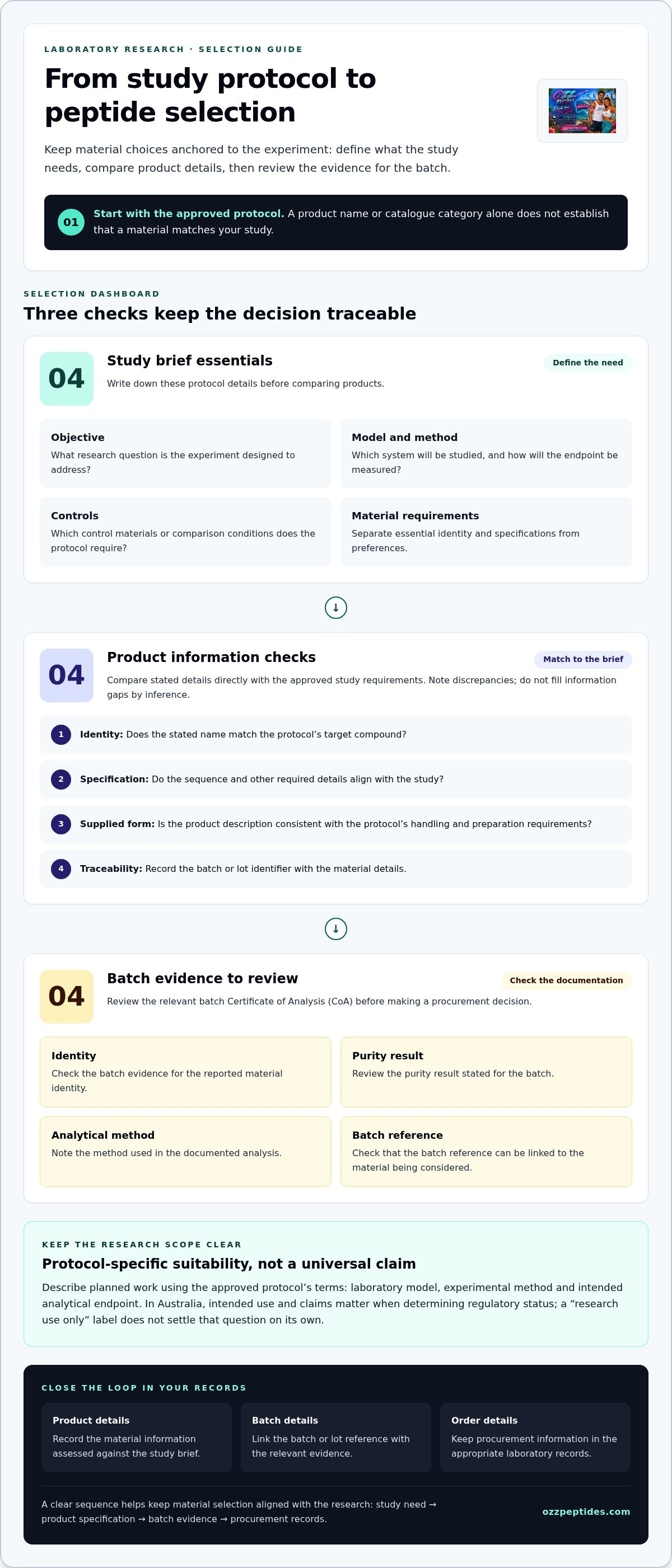
Before comparing products, write down the objective, experimental model and measurement method. Capture the required peptide identity and protocol-defined specifications, such as sequence or modifications. Separate essential requirements from preferences that could change without affecting the study design. This makes it easier to identify a mismatch and explain the selection to colleagues or procurement staff.
- Objective: What research question is the experiment designed to address?
- Model and method: What system will be studied, and how will the endpoint be measured?
- Controls: Which control materials or comparison conditions does the protocol require?
- Material requirements: Which identity and specifications are essential, and which details are preferences?
Keep this brief nearby as you assess materials. If the study calls for a particular sequence, a similar-sounding name is not enough to establish a match. For background on how peptides are used in laboratory settings, the guide Scientific Research Peptides: A Clear Guide to Their Role in the Lab provides a useful companion read. Researchers can also explore custom peptide synthesis as a general approach to producing defined peptide sequences for research applications.
How do you keep the research scope clear?
Describe the planned work using the terms in the approved study protocol: laboratory model, experimental method and intended analytical endpoint. Keep those descriptions distinct from clinical, therapeutic or personal-use language. In Australia, intended use and claims matter when determining regulatory status; a “research use only” label does not, by itself, settle that question.
Research suitability is protocol-specific, not universal: a material must match the requirements and intended scope of the particular laboratory study.
This distinction keeps procurement decisions anchored to the experiment rather than broad claims about what a peptide might do. If the protocol changes, revisit the material requirements and the study’s approvals before proceeding. A clear brief makes the next steps more straightforward: assess identity and specifications against the protocol, then review the relevant product and batch information.
Peptide selection checklist: match identity, specifications and study design
Once your study requirements are clear, assess each candidate in the same order: confirm the peptide’s identity, compare its stated specification with the protocol, then check whether the material information aligns with the study design. This keeps the decision grounded in documented details rather than catalogue categories or product trends.
The exact compound matters. Similar names, broad category labels and marketing descriptions don’t establish that two materials are equivalent. A difference in sequence or another protocol-defined detail may mean a material doesn’t match the study, even if its name sounds familiar. Use the approved protocol as your reference point and note discrepancies instead of assuming they are insignificant.
Which product details belong on the checklist?
Compare the product information directly with the study brief. Capture the stated peptide identity and specification, the supplied form, and any product-specific details the laboratory protocol makes relevant. Record the batch or lot identifier so your selection can be traced in research records and linked to the material received.
- Identity: Does the stated name match the protocol’s target compound?
- Specification: Do the sequence and other required details align with the approved study?
- Supplied form: Is the product description consistent with the handling and preparation requirements in your protocol?
- Traceability: Have you recorded the batch or lot identifier alongside the material details?
Don’t fill gaps by inference. If a listing gives a broad description but your protocol calls for a specific sequence or modification, the broad label alone can’t demonstrate a match. Record what the product information states and compare it with the study requirements.
How should researchers assess study fit?
Compare the stated material information with the experimental model and analytical method. Ask whether the documented identity and specification meet the protocol’s requirements and whether the product details support the planned laboratory work. A material description tells you what is being offered; it doesn’t, on its own, establish suitability for a particular experimental question.
Study fit depends on protocol-defined requirements, not on a peptide’s category name or a general claim of research suitability.
Keep expected outcomes separate from supplier descriptions. A category such as “cell research” or “metabolic research” may help describe a material, but it can’t replace the study’s own criteria. A product claim also shouldn’t be treated as evidence that the material will produce a particular result. For peptides for laboratory research, match documented details to the experiment, then assess the relevant batch evidence.
If your study specifies a non-standard compound or reagent, OZZ Peptides offers custom research product sourcing. You can browse OZZ Peptides’ research offerings with your protocol-defined criteria in hand.
Research peptide documentation: what batch evidence can tell you
A Certificate of Analysis (CoA) provides batch-specific information to consider alongside the product description and study protocol. It can connect a material to reported analytical results, but it doesn’t determine whether that material suits a particular experiment. Read it as evidence about the batch, then compare its details with the requirements your team has already set.
Start by checking whether the document identifies the relevant compound and the batch or lot being assessed. Note the analytical method and reported result. A clear batch reference helps link the document to the material under consideration and to the records your laboratory keeps.
What evidence should researchers look for?
Use the CoA as part of a cross-check. Compare the compound identity and batch details with the product information, then check that they align with the protocol-defined study requirements. If a document reports a result without clearly identifying the batch, it may be difficult to trace. Keep the review focused on what the document actually states.
| Document detail | What to check |
|---|---|
| Identity | Is the named compound consistent with the product information and study requirements? |
| Purity result | What result is reported, and how is it presented? |
| Analytical method | Which method does the document name alongside the result? |
| Batch reference | Does the batch or lot identifier connect the document to the material? |
These fields help organise a review, but don’t replace one. A reported purity figure, including one obtained using high-performance liquid chromatography (HPLC), doesn’t answer every question about identity, other material attributes or compatibility with a study. Read the method and result in context, and don’t treat a single number as a complete assessment of the material.
What can analytical results not establish by themselves?
Analytical results describe what the document reports. By themselves, they don’t show that a peptide is suitable for every experimental model or analytical question, or guarantee that a study will produce a particular outcome. Study fit still depends on the approved protocol and the material requirements set for that work.
A batch result is evidence about what was reported for that batch, not a conclusion about universal research suitability or experimental outcome.
Keep the CoA with the product and procurement records so your team can revisit the evidence later. OZZ Peptides’ research-grade peptides are supported by independent third-party Certificates of Analysis. Review the applicable batch document alongside the product information rather than assuming that a general description or purity result settles every research question. This keeps documentation useful and appropriately scoped for peptides for laboratory research.
Before ordering peptides for laboratory research: plan records and receipt checks
A tidy procurement record starts before the order is placed. Confirm that the material matches the approved study specification, the quantity fits the planned work and the required internal purchasing approval is in place. This gives the research team and procurement staff a shared reference and helps prevent ordering against an outdated protocol or informal preference.
What should be settled before placing an order?
Work through the essentials with the responsible research team. Check the approved specification, quantity, purchasing approval and documentation needed for the laboratory’s records. Allow time for internal procurement steps and delivery coordination so the material can be received and handled in line with your procedures.
- Specification: Match the material details to the current approved protocol.
- Quantity: Confirm the required amount with the team and study plan.
- Approval: Complete internal purchasing and documentation steps before ordering.
- Coordination: Plan who will receive the delivery and where its records will be kept.
If the protocol calls for a non-standard research compound or reagent, custom research product sourcing can be a practical route. OZZ Peptides supplies research materials to Australian researchers, with nationwide online ordering and Express Post dispatch. Include delivery coordination in your plan and allow for it when setting the laboratory schedule.
What should researchers record when materials arrive?
At receipt, connect the delivered material to both the order and the study record. Check the product identification and batch paperwork against what was ordered, then document receipt using your laboratory’s established procedures. This creates a traceable link between the planned material, the batch received and the work in which it may be used.
- Record the product identity, batch or lot reference, order details and receipt date.
- Compare the supplied paperwork with the received material and order record.
- Note any discrepancy and follow your laboratory’s process before using or allocating the material.
- Keep the relevant records together so the team can trace the material later.
Don’t rely on generic handling or storage assumptions. Follow the product-specific information supplied with the material, alongside your laboratory’s procedures and the approved protocol. If instructions appear inconsistent with established procedures, follow the laboratory’s process for resolving the issue before handling the material further.
This check completes the chain from approved specification to authorised order, received batch and complete records. Once your team has settled its requirements and procurement steps, order research-grade peptides and laboratory research materials from OZZ Peptides.
A practical next step for Australian peptide research procurement
A straightforward procurement process links the study need to the material ordered and the batch received. Keep one written checklist with the protocol-defined requirement, product details, batch evidence and purchasing record. This shared reference helps researchers and procurement staff work from the same information rather than relying on a catalogue description or scattered notes.
How can researchers make the procurement process manageable?
Before ordering, confirm the study need and specification with the responsible research team. Match the material information to the approved protocol, review the relevant batch evidence, then record the procurement through your laboratory’s established process. Plan around internal approvals and the research schedule, including who will receive the order and manage its records. For non-standard compounds or reagents, custom research product sourcing provides another procurement route.
- Confirm: The study requirement and approved specification.
- Match: Product details to the protocol-defined material need.
- Review: The applicable batch evidence alongside the product information.
- Document: The approval, order details and batch reference in appropriate records.
Keep the checklist current if the study plan changes. A revised requirement may affect the material specification or quantity, so update the procurement record in line with your laboratory procedures. For peptides for laboratory research, this sequence keeps the decision focused on the study and makes it easier to trace how a material was selected.
What can a research-focused supplier contribute?
Product and batch documentation can support an informed procurement decision by giving your team details to compare with its study requirements. OZZ Peptides supplies research-grade peptides, laboratory reagents and research compounds to Australian researchers. Its research peptides are supported by independent third-party Certificates of Analysis, which your team can review as batch evidence alongside the approved protocol and product information.
Secure online ordering and nationwide Express Post dispatch provide practical ordering and delivery options for Australian laboratories. Include delivery coordination in your research schedule. For a non-standard research requirement, custom sourcing can bring the material request into the same clear process: define the study need, document the specification and link the order to the relevant research records.
Before proceeding, make sure your team has a clear study requirement, a matched product specification, the relevant batch documentation and an approved procurement record. These checks help keep material selection organised from planning through receipt. Explore OZZ Peptides research supplies for research-focused materials and sourcing options.
Set up your next research purchase with confidence
Make your next step practical: turn the study’s material requirements into a procurement note your team can update as the work develops. That note keeps decisions about peptides for laboratory research connected to the protocol and gives colleagues a clear reference when requirements or purchasing plans change.
For Australian laboratory research, OZZ Peptides supplies research materials supported by independent third-party Certificates of Analysis for batch review. If your protocol calls for a non-standard compound or reagent, custom sourcing is another option. Keep the intended work and approved study requirements at the centre of the decision.
When you’re ready to explore materials for scientific and laboratory research, explore research peptides and laboratory supplies. A clear plan makes the next procurement step easier to organise.
Frequently Asked Questions
What should I check before selecting a peptide for laboratory research?
Start with the approved study protocol, then check whether the candidate material matches the experiment’s actual requirements. For peptides for laboratory research, compare the documented identity and specification with the planned model and measurement method. If the protocol is amended, use the current approved version rather than an old order note. Record any mismatch for the research team to resolve before procurement instead of assuming a similar product description is close enough.
Does a Certificate of Analysis prove that a peptide is suitable for my study?
No. A Certificate of Analysis reports information about a particular batch, but it can’t determine whether that material fits your research question. A document may report identity and analytical results while your study requires a specific sequence or form. Use the CoA as supporting evidence, compare it with the protocol and product information, and keep that assessment with your procurement records. It doesn’t guarantee an experimental result.
Is HPLC purity enough to assess a research peptide?
No. An HPLC purity result is one reported analytical measure, not a complete assessment of identity, every quality attribute or study compatibility. Check which batch the report refers to and what method and result it states. A purity figure alone won’t tell you whether the material matches a protocol-defined sequence. Consider the available documentation together, and don’t treat one number as proof of experimental performance.
Can research peptides be used for human consumption or treatment?
No. OZZ Peptides supplies its materials strictly for scientific and laboratory research purposes. They are not products for human consumption, prescription medicines, pharmaceutical drugs, medical treatments or injectable medicines. Keep the material’s use within the laboratory research scope described by the approved work. A research label is not permission to use the product for personal or therapeutic purposes.
How should laboratory research peptides be stored?
Follow the storage instructions supplied for the specific product and its form, together with your laboratory’s established procedures. Don’t assume that guidance for one peptide applies to another. On receipt, keep the product identification and accompanying instructions connected to the material so the team can refer to them during storage and handling. If information is unclear or conflicts with laboratory procedures, follow your institution’s process for resolving it before use.
How much peptide should a laboratory order for a study?
Calculate the amount from the approved experimental plan, not from another study or a general product description. Include planned runs, controls and any repeats already allowed for in the design, then have the responsible team review the calculation and purchasing approval. Keep the rationale with the order record so it’s clear how the quantity was set. For non-standard compounds or reagents, custom research product sourcing is available to Australian research teams.