

Research-Grade Peptides: What the Term Means for Australian Research

“Research-grade” can sound like a formal quality seal. It isn’t a universal certification. For research-grade peptides, the practical question is what evidence supports the description for a specific batch, and whether that evidence is relevant to your laboratory work.
Product labels and quality documents can be difficult to compare. A batch-level Certificate of Analysis (COA) can offer useful context, but its value depends on what the document identifies and which tests it reports. In Australia, “research use only” wording also doesn’t determine regulatory status on its own. The Therapeutic Goods Administration says intended therapeutic use remains relevant.
This guide explains what the term can and can’t tell you, which product details and testing records to look for, and how to assess whether they fit your laboratory research. Documentation supports informed evaluation, not guaranteed experimental outcomes. OZZ Peptides supplies research-only peptides and laboratory compounds across Australia, with independent third-party COAs accompanying its research-grade peptides.
Key Takeaways
- Understand why research-grade peptides describes intended research use, not a universal certification.
- Learn what to look for in a Certificate of Analysis and how to connect its findings to an identified batch.
- Compare research-grade, analytical-grade and pharmaceutical-grade terms with their different contexts and limitations.
- Use a practical sequence to assess whether a material’s description and documentation suit your research question.
- Explore OZZ Peptides as an Australian source of research-only peptides and laboratory compounds.
What does research-grade peptides mean in a laboratory context?
In a laboratory context, research-grade peptides are materials supplied for scientific and laboratory research. The phrase describes the product’s intended research-use category. It isn’t a universal certification, and it doesn’t establish every detail about a material’s identity, composition or quality.
That distinction matters when comparing product descriptions. A label indicates how a product is presented, but assessing a specific material calls for more detail, including product information and batch documentation. Look for evidence that relates to the material being supplied rather than relying on the grade wording alone.
These products are strictly for scientific and laboratory research. They aren’t medicines or products for human consumption. In Australia, “research use only” wording doesn’t determine regulatory status on its own if a product is intended for therapeutic use. Intended use matters; a disclaimer isn’t a substitute for understanding what a product is supplied for.
What does the research-grade label tell you?
The label signals a research-use category, not proof of every quality attribute. Supporting detail depends on the product information and evidence available for its particular batch. A Certificate of Analysis (COA), for example, can report specified analytical findings, but its value depends on what it identifies and which tests it records.
Read the product description alongside the documentation. Check that the material named in the records matches the product you’re assessing, then note which characteristics the document addresses. Even useful evidence can’t establish suitability for every research question. That depends on the study’s purpose and requirements.
What the term does not promise
There isn’t one universal purity threshold built into the words “research-grade”. Suppliers may use the term in different ways, so the phrase alone doesn’t tell you which analytical methods were used or what a particular batch’s results were. Look for evidence that states its scope clearly instead of assuming the label carries a fixed technical meaning.
Nor does a quality description guarantee experimental performance or outcomes. Research findings depend on many factors beyond a product’s stated grade. Batch documentation can help you understand what was tested, but it can’t promise how a material will behave in your specific study.
Research-use labelling describes the product’s intended category; batch-specific analytical evidence reports findings about an identified material.
Keep those ideas separate when assessing a product. First, understand its stated research purpose. Then review the evidence for the batch and consider whether it addresses characteristics relevant to your work. This provides a clearer basis for evaluating research-grade peptides than treating a broad label as a complete quality assessment.
What evidence can support a research-grade peptide claim?
A Certificate of Analysis (COA) can provide useful evidence by recording analytical findings for a particular batch. It connects a general supplier description with information tied to material identified in a report. Its value comes from the details it gives, not simply from being labelled “COA”.
Start by checking whether the report clearly identifies the material and batch it covers. Then review what was tested, which methods were used and what findings were reported. A supplier description explains how a product is presented; batch documentation records specified tests on identified material. They serve different purposes.
What can batch documentation help establish?
A COA can help you understand which characteristics were examined for the batch named in the report. It doesn’t automatically cover every characteristic you might need to assess. Compare the material description and batch identifier in the report with the product information, then check whether the document states the analytical method and findings clearly.
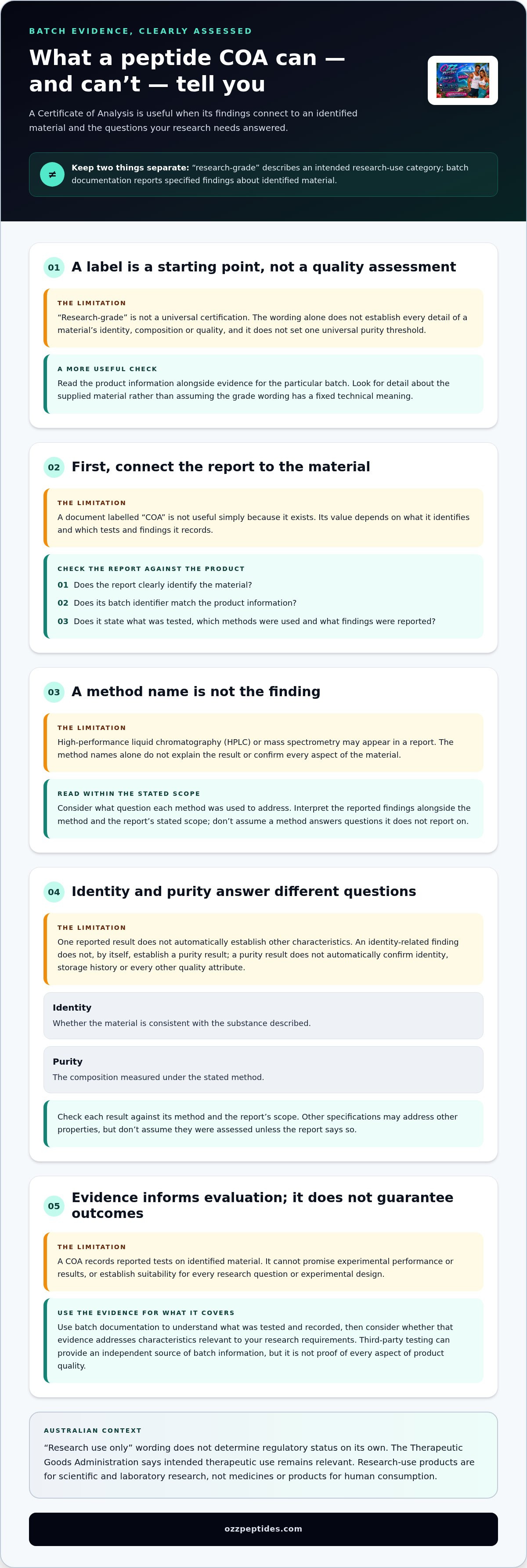
Methods such as high-performance liquid chromatography (HPLC) or mass spectrometry may appear in analytical reports. Their names alone don’t explain the result. Consider what question each method was used to address, and interpret the findings within the report’s stated scope. Don’t assume a method confirms every aspect of the material.
A COA describes reported tests on identified material, not guaranteed results in your study. This distinction keeps documentation useful without asking it to promise more than it reports.
Why the scope of testing matters
Different tests answer different questions. Identity concerns whether the material is consistent with the substance described. Purity concerns the composition measured under the stated method. Other specifications may address other properties, but don’t assume they were assessed unless the report says so.
Read each result alongside its method and the report’s stated scope. For example, an identity-related finding doesn’t, by itself, establish a purity result. Likewise, a reported purity result doesn’t automatically confirm identity, storage history or every other quality attribute. Avoid drawing conclusions beyond the evidence presented.
Third-party testing can provide an independent source of batch information. It still isn’t proof of every aspect of product quality, nor does it establish that the material suits every experimental design. Use the report to evaluate what was tested and recorded, then consider how that evidence relates to your research requirements.
OZZ Peptides supplies research-grade peptides with independent third-party COAs. Reviewing product information alongside batch documentation gives Australian researchers practical context for evaluating research materials. Explore research-grade peptides for scientific and laboratory research, and review the available documentation to understand the evidence associated with the material.
Research-grade vs analytical-grade and pharmaceutical-grade peptides
Grade labels can look like a simple ranking, but they don’t necessarily describe a shared scale. Research-grade, analytical-grade and pharmaceutical-grade refer to different contexts. Their meaning can also vary between suppliers and scientific settings, so comparing labels alone may tell you little about whether materials are equivalent.
Use the terms as starting points, then check the product’s stated purpose, specification and supporting documents. This comparison shows the kinds of questions each label raises, not a universal definition or certification system.
| Term | Common context | What to examine | Limit of the label |
|---|---|---|---|
| Research-grade | Scientific and laboratory research | Product information and batch-specific test records | Doesn’t establish suitability for every study or confirm all quality attributes |
| Analytical-grade | Analytical laboratory applications | The stated specification and test evidence for the intended analysis | Doesn’t guarantee a particular peptide specification based on wording alone |
| Pharmaceutical-grade | Pharmaceutical production or related quality contexts | The applicable requirements and documentation for that context | Doesn’t mean a research material meets medicine or clinical-use requirements |
These categories aren’t interchangeable steps on a ladder. A material described with one term shouldn’t be assumed to meet the expectations attached to another. Compare the specifics: what does the supplier say the material is for, what is documented, and does that information align with the work you plan to do?
How analytical-grade language differs
“Analytical-grade” is commonly associated with analytical laboratory applications, where a material may be assessed against a stated specification for a particular purpose. The phrase alone doesn’t guarantee that a peptide meets a defined specification. Read the specification and test evidence, and consider whether they address the requirements of your analysis.
Why pharmaceutical or clinical terminology needs care
Pharmaceutical or clinical language refers to a different context from research-only supply. It doesn’t automatically describe research materials, and research-grade materials shouldn’t be assumed to meet medicine or clinical-use requirements. Keep the intended use and evidence clear, especially if a label sounds more authoritative than its documentation supports.
Grade labels are not equivalent certifications; compare the stated context and supporting evidence instead. For Australian laboratory research, assess research-grade peptides using the information supplied for the material and its documented testing, not assumptions drawn from pharmaceutical or analytical terminology.
A practical check is to ask whether the label answers your research question. If it doesn’t, examine the stated specification and available batch documentation. This keeps the comparison grounded in evidence rather than a supposed hierarchy of grades.
How to assess whether a research-grade peptide fits your study
A clear assessment starts with the research question, not the product label. Use this sequence to organise your review:
- Define the research need. Identify the material characteristics your approved study design calls for.
- Identify the material. Compare its stated identity and form with your research plan.
- Review the evidence. Check product information and batch documentation for details relevant to your assessment.
- Check handling guidance. Follow product-specific instructions and relevant safety information for handling and storage.
Each step answers a different question. A description may name a peptide, while batch documentation records specified findings about identified material. Handling guidance addresses practical precautions. Keep those roles distinct, and assess the exact material described rather than relying on a broad grade label.
Match the material details to the research question
Compare the stated peptide identity and any specified form with the material required by your research plan. Similar names don’t establish that two materials have identical characteristics. If a detail is unclear or differs from the study specification, don’t assume the materials are interchangeable.
Suitability depends on the approved study design and your institution’s procedures. Check that the product description aligns with the question being investigated, and keep the decision within the relevant research and safety processes. This documentation review doesn’t replace study approval or institutional oversight.
Use documentation as evidence, not a shortcut
Review the batch identifier and confirm that it corresponds to the material under consideration. Then read the report’s stated scope: which material it describes, which tests it records and what findings it gives. A document can support your assessment, but it only speaks to the information it contains.
Next, consult the product-specific instructions and relevant safety documentation for handling and storage requirements. Don’t fill gaps with assumptions or general advice intended for a different material. Keep the records with your study documentation so the basis for your assessment remains clear.
For more detailed report-reading support, use dedicated guidance on interpreting a Certificate of Analysis and understanding purity reporting. Those topics require a closer look at how analytical findings are presented, while this checklist focuses on matching evidence to a research need.
Assess research-grade peptides through a straightforward chain: research question, exact material description, relevant documentation and handling guidance. OZZ Peptides supplies research materials for scientific and laboratory use, with independent third-party Certificates of Analysis accompanying its research-grade peptides. Explore research peptides for laboratory research and review the product information for your assessment.
Where Australian researchers can source research-grade peptides
Once you’ve matched a material to your research needs, sourcing is the next practical step. Look for a research-focused supplier that presents materials for scientific and laboratory use, provides relevant product information and makes supporting documentation accessible for review.
What Australian research customers can expect from OZZ Peptides
OZZ Peptides supplies research peptides, reagents and laboratory compounds to researchers across Australia. Its research-grade peptides are accompanied by independent third-party Certificates of Analysis (COAs). These batch documents provide information about reported testing, giving research customers useful context when reviewing supplied materials.
Documentation supports assessment, not certainty about how a material will perform in a study. Review the product description and available batch records together, and consider whether the documented details align with your research requirements. Base handling and storage decisions on the product-specific instructions and relevant safety information.
Practical supply matters too. OZZ Peptides offers secure online ordering and nationwide Express Post delivery, alongside customer care. These options help Australian research customers organise sourcing and get support with the purchasing process, while materials still need to be assessed against their study requirements.
Take the next step with research-focused sourcing
Before ordering, compare the exact product description with your research need. Review the available batch documentation for the material it identifies and the testing it reports. This keeps the decision grounded in the details provided rather than relying on a grade label alone.
For research that requires a non-standard material, OZZ Peptides offers custom research product sourcing. This service supports specific sourcing requirements while keeping the focus on laboratory research. Assess any material against the intended study and applicable institutional procedures.
OZZ Peptides focuses on research-only peptides and laboratory compounds for scientific work in Australia. Secure online ordering and nationwide Express Post delivery provide a straightforward way to source research supplies, while product information and COAs support a considered review of the materials. Explore research-grade peptides and laboratory supplies.
Make your next sourcing decision with confidence
Turn your assessment into a reference point for future work. Record why a material was selected, which product details mattered to the study and what documentation informed the decision. This gives your team a consistent way to review sourcing choices as research needs evolve, without treating a grade label as a shortcut.
For your next sourcing decision, match your research requirements with the product information and keep the intended laboratory use clear. OZZ Peptides supports Australian research customers with independent third-party Certificates of Analysis, nationwide Express Post delivery and research-focused customer support.
Explore research-grade peptides and laboratory supplies for scientific and laboratory research. A considered sourcing process starts with clear requirements and puts your research team in a stronger position to move ahead.
Frequently Asked Questions
Can research-grade peptides be used in humans?
No. OZZ Peptides supplies research-grade peptides strictly for scientific and laboratory research. They aren’t medicines, medical treatments or products for human consumption. A research label or analytical document doesn’t make a product suitable for personal, therapeutic or clinical use. Keep materials within their stated research purpose, and follow the applicable laboratory procedures and institutional requirements for your work.
What does a peptide sequence tell a researcher?
A peptide sequence describes the order of amino acids in a molecule. It can help distinguish the intended peptide identity from other materials, but it doesn’t verify the identity or purity of a particular supplied batch. Matching sequence information in two descriptions, for example, doesn’t prove the materials are equivalent. Compare the sequence and product description with the batch records before drawing conclusions about a supplied material.
Do research-grade peptides have an expiry date?
Expiry or retest information depends on the specific material and its documentation. Check the product information and batch documents for any stated date and relevant storage instructions. Don’t assume a standard shelf life or transfer storage advice from one material to another. If the documentation doesn’t make the applicable conditions clear, follow your laboratory’s procedures and product-specific guidance rather than guessing about continued usability.
Can a Certificate of Analysis guarantee experimental results?
No. A Certificate of Analysis records specified tests and findings for a batch; it can’t predict performance in every experiment. Results can also depend on the research question, study design and other experimental conditions. A COA shouldn’t be taken as a promise of reproducibility, a particular biological effect or a specific result. Use it to understand the reported evidence, then assess the material within your study.
Is research-grade the same as clinical-grade?
No. These labels describe different contexts and shouldn’t be treated as interchangeable. Research-grade refers to material supplied for research purposes, while clinical terminology may imply a different use and set of requirements. A label alone doesn’t show that research material is appropriate for clinical use or human consumption. Keep the intended purpose clear and assess the specific documentation without inferring clinical suitability from a grade description.
What should a researcher do if a peptide label and its batch document differ?
Pause and don’t rely on the material until the discrepancy has been addressed. Compare the exact product description, batch identifier and document details; similar names don’t resolve a mismatch. Follow your laboratory’s procedures for recording and managing discrepancies. OZZ Peptides’ research-focused customer support can help with product information and documentation questions, so your team can avoid assumptions about the material or using it outside its stated research purpose.