

Scientific Research Peptides: A Clear Guide to Their Role in the Lab

What makes a peptide a research compound: its label, or the scientific question a laboratory is asking? The distinction matters. Scientific research peptides are studied in controlled laboratory settings, but a research label doesn’t make a compound a medicine or supplement, or establish that it’s safe or effective for people.
Peptides are short chains of amino acids, and researchers may investigate their structure, interactions and biological activity. What a study can show depends on its methods and scope. A laboratory finding is not proof of a human health benefit, even when it is presented confidently online.
This guide explains what peptides mean in a scientific context, how researchers frame research questions and why results have limits. It also covers responsible communication, laboratory-only use and the role of batch documentation, such as an independent third-party Certificate of Analysis. Use these points to distinguish what a study established from claims its evidence doesn’t support.
Key Takeaways
- Recognise scientific research peptides as laboratory materials, distinct from medicines and supplements.
- Match a research question to an appropriate model and validated methods rather than assuming one approach fits every study.
- Assess findings in context: consider controls, replication, limitations and publication details before drawing conclusions.
- Use a clear research process: define the question, review evidence, document materials and follow institutional approvals and laboratory procedures.
- For Australian laboratory research, OZZ Peptides supplies research peptides and reagents with independent third-party Certificates of Analysis for batch documentation. These documents don’t establish research outcomes.
What are scientific research peptides, and what does the term mean?
Peptides are short chains of amino acids, the building blocks that also make up proteins. The amino acids are joined by chemical links called peptide bonds. In a laboratory, a peptide may be studied to investigate a defined question, such as its structure or interaction with another molecule. The phrase scientific research peptides describes materials used in laboratory investigations, not a special class with automatic approval or proven effects.
Research peptides are peptide materials examined in laboratory studies to answer defined scientific questions. This keeps the focus on the research purpose and setting, not on claims about what a compound might do in people.
For a foundational overview of peptide structure and general biological roles, see What are Peptides?. In scientific writing, the exact meaning of a term depends on how researchers define and use it in a particular study.
How are peptides different from proteins?
Both peptides and proteins consist of amino acids joined by peptide bonds. They’re related terms, not completely separate kinds of material. People often use “peptide” for a shorter chain and “protein” for a longer, more structurally complex chain, but there’s no single size cut-off that applies in every context. Read a paper’s terminology alongside its description of the molecule and methods.
Think of the terms as labels that help describe a molecule, rather than a strict dividing line. A study might call a chain a peptide because that’s its established name or because of the research context. The label alone doesn’t explain how the molecule behaves, what the experiment found or whether the finding applies beyond the model tested.
What does “for research use” mean?
“For research use” identifies the stated laboratory context for a material. It doesn’t mean the material has been approved for human use, shown to be safe or effective for people, or established as suitable for consumption or treatment. A research designation is not a result, recommendation or clinical claim. Keep those distinctions clear when reading labels, product descriptions and study summaries.
The wording doesn’t establish quality by itself, either. Documentation can help identify and describe a particular batch, but its value depends on what information it contains and what that information supports. An independent third-party Certificate of Analysis can provide batch documentation; it doesn’t demonstrate that a compound produces a particular research result or establish a human health benefit.
For researchers, the practical takeaway is to interpret a material through its documented identity, the study question and the methods used. Don’t treat a familiar name or research-use label as a substitute for evidence. To assess what a study can show, start with its question and research methods.
How do researchers study peptides in laboratory settings?
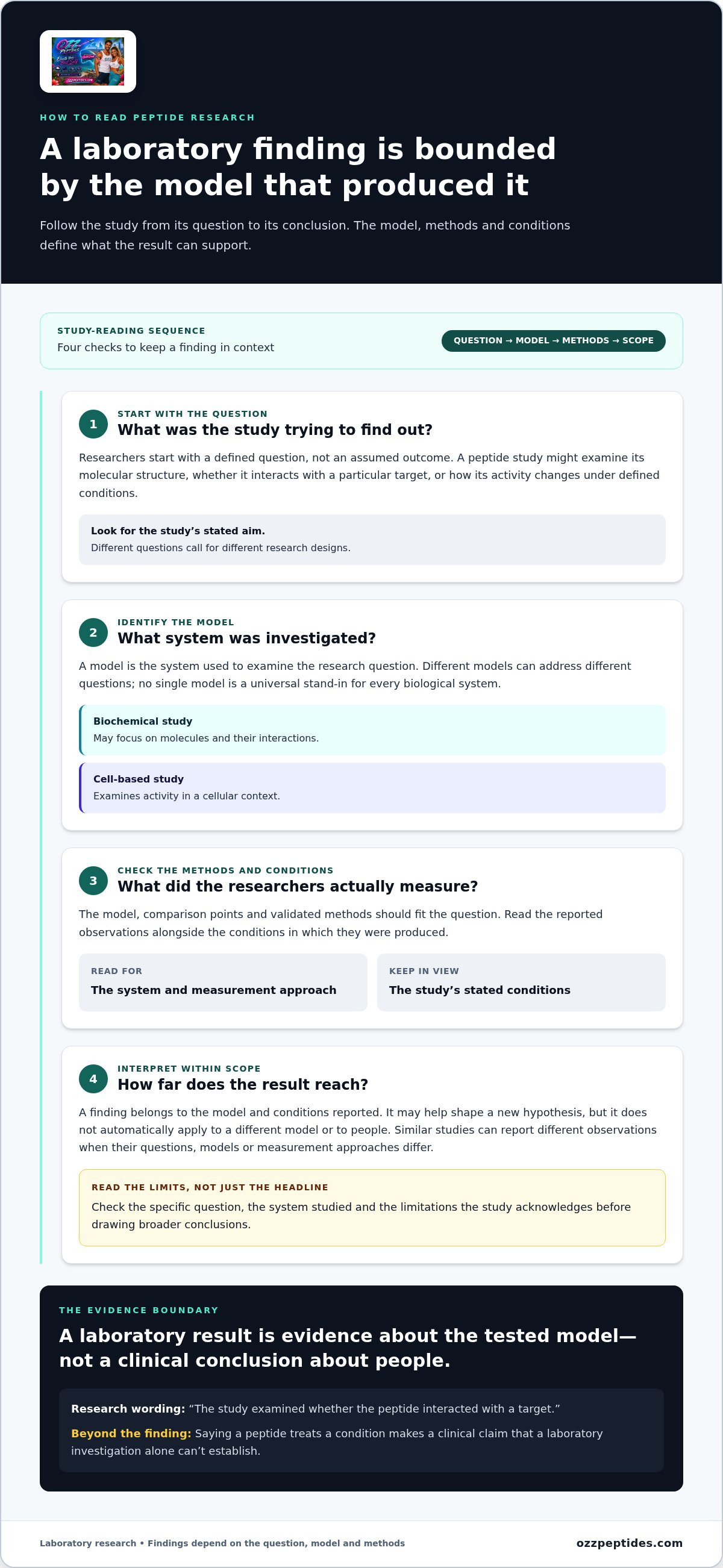
Researchers start with a question, not an assumed outcome. They might ask how a peptide is structured, whether it interacts with a particular biological target, or how its molecular activity changes under defined conditions. Those questions call for different research designs. The model, comparison points and validated methods should fit the question being investigated.
When reading a study, first identify what it set out to measure. A paper may describe an interaction in a biochemical system, an observation in a cell-based model or another laboratory finding. Each result belongs to the conditions and model reported. It doesn’t automatically explain what would happen in a different system or establish a broader biological effect.
What kinds of questions can peptide research explore?
At a high level, peptide studies may examine molecular structure, binding to a target or interactions between molecules. Researchers may also investigate how particular features of a peptide relate to an observed molecular activity. These are areas of inquiry, not promises that a peptide will produce a specific effect. When an article gives an example, check it against relevant peer-reviewed sources and describe it in line with what those studies actually tested.
Clear language helps. “The study examined whether the peptide interacted with a target” describes a research question. “The peptide treats a condition” makes a clinical claim that a laboratory investigation alone can’t establish.
Why does the research model matter?
A model is the system researchers use to examine their question. A biochemical study may focus on molecules and their interactions. A cell-based study examines activity in a cellular context. Other research settings can address different questions. No model is a universal stand-in for every biological system. The relevant model depends on what investigators want to learn and what their methods can validly measure.
Conditions matter, too. A finding from one model may help shape a new hypothesis, but it doesn’t automatically apply to another model or to people. Interpret the result within its stated scope, including the limitations the study acknowledges. Two studies on a similar peptide can report different observations because their models, questions or measurement approaches differ.
An observed laboratory result is evidence about the tested model, not a clinical conclusion about people. Look for the specific question, the system studied and the limits of the reported observation before drawing broader conclusions.
For laboratory projects, material selection should follow the documented research question and the requirements of the study. OZZ Peptides supplies research peptides and reagents for scientific research in Australia, with independent third-party Certificates of Analysis supporting batch documentation. That documentation describes a batch; it doesn’t establish what a study will find.
How should readers interpret research peptide evidence and claims?
Research claims can sound more certain than the evidence behind them. To assess a statement, separate what researchers directly observed from what they infer, what they propose for future study and what would require clinical evidence. These are different levels of claim, and keeping them distinct helps you judge what a study actually supports.
A laboratory study can report a result within its specific model, conditions and measurements. Researchers may interpret what that observation could mean or propose a hypothesis for further investigation. Neither step, on its own, establishes broad safety or effectiveness in people. Study design, appropriate controls, repeatability and the wider publication context all affect how much weight a result can carry.
What can a laboratory study establish?
A study can support a finding about what happened under the conditions it tested. Controls help researchers compare results and consider other explanations; replication can show whether an observation is repeatable. Check the study’s limitations and whether its methods match the question. A careful summary describes the model and result rather than turning a preliminary observation into a general claim about people.
| Evidence statement | What it may establish | What it doesn’t establish by itself |
|---|---|---|
| Laboratory observation | A measured result in the tested model and conditions | A general effect across other models or people |
| Interpretation | A reasoned explanation of an observation | That the explanation is confirmed |
| Hypothesis | A question or proposed explanation for further research | A demonstrated outcome |
| Clinical claim | A claim that needs relevant clinical evidence | Proof supplied by a laboratory result alone |
Use wording that matches the evidence. “The study observed…” reports a result. “The authors suggest…” signals interpretation. “This may…” can introduce a hypothesis, but it shouldn’t be presented as a proven outcome. The phrase scientific research peptides describes a research context; it doesn’t change the standard of evidence needed to support a claim.
How do research documentation and scientific evidence differ?
Analytical batch documentation and published biological research answer different questions. A Certificate of Analysis (CoA) provides information about a particular batch according to the tests and details recorded in that document. It isn’t a clinical study, scientific endorsement or proof of biological outcomes. Read it for what it documents, not for conclusions it cannot support.
OZZ Peptides’ research peptides are supported by independent third-party Certificates of Analysis. Use the document to review batch information, while looking to relevant research for evidence about biological activity. A CoA and an experimental finding serve different purposes, so don’t use one as a substitute for the other.
What does responsible laboratory research with peptides involve?
Responsible research starts before a study begins. A clear question, relevant evidence and a suitable model help keep the work focused. Accurate material records, appropriate institutional oversight and careful reporting matter as well. This framework supports sound scientific practice without substituting for a laboratory’s own procedures or safety requirements.
What should researchers clarify before a study?
First, define what the study aims to investigate and what its model can reasonably show. A question about a molecular interaction, for example, needs a design suited to that question. Record the reasoning behind the design and the evidence sources that informed it. This makes the study’s scope easier to understand and its decisions easier to review.
Next, identify the relevant institutional review, governance and laboratory safety requirements. These depend on the research context, materials and setting, so follow the procedures and applicable safety documentation for the institution and work involved. A general article isn’t a substitute for local approvals or expert oversight.
A practical planning sequence can help keep the work organised:
- Define the question: State what is being investigated and what is outside the study’s scope.
- Review the evidence: Consider relevant research and note uncertainties that affect the design.
- Document materials: Keep records that identify the materials used and the available supporting documentation.
- Follow local requirements: Use applicable institutional approvals, laboratory procedures and safety documentation.
- Interpret cautiously: Keep conclusions tied to the observations and conditions reported.
Good documentation provides a clear record of research materials and decisions. It doesn’t replace approved procedures or establish what a study will find. For practical handling considerations, follow your institution’s guidance and consult dedicated research reagent handling guidance when preparing laboratory documentation.
How can researchers communicate findings responsibly?
Reports should make the question, model, methods, observed results and limitations clear. That gives readers a fair basis for judging what the work supports. Separate direct observations from interpretations and hypotheses, and avoid turning a proposed explanation into a promised outcome. The strength of the wording should match the strength of the evidence.
Keep laboratory findings distinct from human health advice and treatment claims. A result in a research model doesn’t establish human safety, effectiveness or therapeutic benefit. Responsible communication also avoids promotional language that suggests more than the study tested. This applies to articles, presentations, product descriptions and summaries of scientific research peptides.
For laboratory projects, OZZ Peptides supplies research peptides, reagents and laboratory compounds for scientific research in Australia. Explore research reagents for laboratory work, with material selection guided by your documented research question and laboratory requirements.
Where can Australian researchers source scientific research peptides?
Start with the documented research question, then identify materials that fit the study design and the laboratory’s requirements. This keeps sourcing practical: the material, its supporting records and the research purpose should make sense together. A product description alone can’t determine whether a material is appropriate for a particular study.
For Australian laboratories, OZZ Peptides supplies research peptides, laboratory compounds and reagents for scientific research. Its research peptides are supported by independent third-party Certificates of Analysis (CoAs). These provide batch documentation, not evidence that a peptide will produce a particular result or establish human safety or benefit.
What can Australian laboratories look for in research materials?
Look for a clear description of the stated research-use context and accessible documentation relevant to the material. Compare that information with the study design and institutional requirements. Keep the distinction clear between what a document records and what it can prove. Avoid relying on broad claims about purity, performance or human use unless the claim is supported by appropriate evidence.
Before selecting a material, consider whether its documented identity and available batch information suit the planned work. Check that the study’s requirements align with the laboratory’s procedures and applicable safety documentation. If a detail is important to the project, record how it informed the choice. This creates a transparent link between the research question and the material selected.
- Research context: Is the material clearly described for laboratory research?
- Documentation: What batch information is provided, and what does it actually establish?
- Study fit: Does the material align with the documented question and study design?
- Local requirements: Does its use fit institutional procedures and applicable safety documentation?
How does OZZ Peptides support research sourcing?
OZZ Peptides supplies research peptides and reagents to researchers across Australia, alongside laboratory research compounds and custom research product sourcing. Researchers can use product and batch information as part of their own assessment, while grounding selection in the project’s documented needs. A Certificate of Analysis supports batch documentation; it doesn’t validate a hypothesis or predict the outcome of an experiment.
Secure online ordering and nationwide Express Post dispatch support access to laboratory research materials across Australia. Compare the research question with the material category and documentation that support the planned work. Keep the intended use within scientific and laboratory research, and follow your institution’s requirements.
To take that next step, explore research peptides and laboratory supplies for scientific research in Australia.
Make your next research step count
Let the research question guide what happens next. Before selecting materials, consider what the study needs, what its model can show and which documentation supports your laboratory’s requirements. This keeps work with scientific research peptides focused on evidence and clearly defined research aims, rather than assumptions about outcomes.
For Australian laboratory research, OZZ Peptides supplies research-grade peptides with independent third-party Certificates of Analysis. These documents support batch review; they don’t prove a biological result or establish human safety or benefit. Nationwide Express Post dispatch supports research supply across Australia.
When you’re ready to align materials with your documented research needs, explore research peptides and laboratory supplies. Keep your project grounded in careful evidence, appropriate procedures and clear communication. A well-defined question is a practical starting point for responsible research.
Frequently Asked Questions
What are scientific research peptides?
Scientific research peptides are peptide materials used in laboratory investigations. A researcher might select one to examine a defined molecular question, while another study may focus on a different property. The phrase describes the research context, not a guaranteed result or special level of evidence. To understand a specific material, look at its documented identity and the purpose and limits of the study using it.
Are research peptides the same as medicines?
No. A research-use description doesn’t make a material an approved medicine or establish that it is appropriate for medical use. Medicine status and permitted use depend on applicable Australian requirements, not on wording in a research product description. Keep the categories separate: laboratory materials belong in a research context, while medicines and treatment decisions fall under different regulatory and professional frameworks.
How are peptides used in scientific research?
Researchers use peptides as materials for focused laboratory investigations. For example, a project might examine a peptide’s structure or investigate a molecular interaction in a defined model. The specific role depends on the study question, materials and methods. An abstract can give a quick overview, but check the methods and limitations before describing what the research actually examined.
Can laboratory peptide findings be applied to people?
Not automatically. A finding from a biochemical or cell-based model applies to the conditions tested, and further evidence would be needed to support conclusions about people. When reading a claim, check whether it refers to a laboratory observation, a hypothesis or a clinical finding. Don’t treat an experimental result or product description as evidence of human safety, effectiveness or therapeutic benefit.
What does a Certificate of Analysis tell you about a research peptide?
A Certificate of Analysis (CoA) records batch information and the analyses stated in that document. Its scope depends on the details and results it contains, so read the document rather than assuming it answers every quality question. Check that the batch identifier corresponds to the material being reviewed. A CoA doesn’t establish biological activity, predict a research result or serve as a clinical study.
What should researchers consider when sourcing research peptides in Australia?
Start with the documented research question and your laboratory’s purchasing, governance and safety requirements. Review the material description and any batch documentation, then record why the material fits the project. Australian researchers can source laboratory research materials from OZZ Peptides, which supplies peptides, reagents and research compounds nationally. Keep the intended use strictly within scientific and laboratory research.
Are research peptides intended for human consumption?
No. Research peptides supplied for laboratory investigations aren’t products for human consumption, self-experimentation or treatment. A research-use label doesn’t indicate that a material is suitable for people, and laboratory findings don’t establish that it’s safe or effective for human use. Keep these materials within the stated research context and follow your institution’s procedures and applicable safety documentation.