

Research Peptides Australia: 2026 Guide for Labs

What if “research use only” doesn’t tell the whole story? For Australian labs, sourcing research peptides takes more than checking a label. This 2026 guide covers the essentials of sourcing research peptides in Australia, including intended use, batch records and fit with laboratory processes.
It’s understandable that research-grade claims can be hard to interpret, especially when laboratory compounds are sometimes presented alongside medicines or consumer products. A research-use description doesn’t make a compound an approved medicine, and it doesn’t override how a product is intended to be used. Australia’s regulatory attention to unapproved peptides makes clear boundaries particularly important.
This guide explains what research peptides are, what the term doesn’t imply, and how documentation can support your lab records. It also outlines the practical stages of domestic sourcing, from clarifying research requirements to planning for receipt and record-keeping. OZZ Peptides is an Australian-owned supplier focused on laboratory research, with third-party Certificates of Analysis supporting its research-grade peptides. The aim is simple: help your team make informed, well-documented procurement decisions.
Key Takeaways
- Research peptides are materials for scientific investigation, not medicines or consumer products.
- For Australian labs, distinguish laboratory findings, animal studies and human clinical trials before drawing conclusions.
- Use a clear sourcing workflow: define the research requirement, prepare purchasing details, review documentation and record receipt.
- Match catalogue ordering or custom sourcing to your lab’s requirements, and treat a Certificate of Analysis as batch information, not a promise of experimental results.
What do research peptides mean for Australian laboratories?
Research peptides are materials intended for scientific investigation in a laboratory, not medicines or consumer products. For Australian labs, the phrase describes a research context; it doesn’t establish that a compound is approved for therapeutic use or suitable for people.
A sound purchasing decision starts with the project, not the label. Define the question the team is investigating, the material needed and the records required by your laboratory’s purchasing and receiving processes. Product documentation can help identify what a supplied batch is represented as, while the research plan determines whether it fits the work. Neither a product description nor a document can establish what an experiment will find.
What questions bring Australian labs to research peptides?
Researchers and laboratory buyers may be sourcing materials for a defined investigation, such as examining a peptide’s behaviour in a controlled laboratory model. The aim shapes the requirements: the research team needs to specify the material, relevant batch information and purchasing details clearly enough for internal review and record-keeping. These practical needs are part of what people mean by scientific research peptides. For background on how peptides can be made, see the overview of Peptide Synthesis Methods, including solid-phase and solution-phase approaches.
What does research-use positioning tell you?
A research-use description indicates the stated context; it doesn’t prove that a product is suitable for human use, or answer a scientific question on its own. Keep the label separate from the evidence: assess research findings according to the methods and study type, and check batch documentation for the information it actually provides. The phrase research-grade peptide meaning is best understood in that limited context, not as a claim of therapeutic approval or a guaranteed result.
OZZ Peptides supplies compounds for laboratory research. Its research reconstitution guidance adds practical context for laboratory processes. This overview sets the boundaries; the project’s own requirements should guide procurement and documentation.
What can peptide research show, and what remains uncertain?
Peptide research can produce different kinds of evidence, and each answers a different question. A result from a laboratory experiment may help researchers explore a biological process under controlled conditions. It doesn’t establish that the same effect will occur in an animal or a person, or that a peptide is a proven treatment. For Australian labs, interpreting research on peptides means keeping these evidence stages distinct.
How do laboratory and animal findings differ from clinical evidence?
In vitro research takes place outside a living organism, often using cells or other laboratory models. It can examine specific interactions under defined conditions, but those conditions don’t reproduce the complexity of a whole animal or person. Animal studies examine effects in a living model, while human clinical trials investigate outcomes in people under a study protocol.
Laboratory findings are not animal findings, animal findings are not human clinical trials, and none alone guarantees a particular human outcome. The Australian research landscape includes specialist work in peptide and protein science, including the ARC Centre of Excellence for Innovations in Peptide and Protein Science.
Why do research findings need careful interpretation?
Read a paper in context. Check what the researchers set out to test, which model they used, how the experiment was conducted and what limitations they reported. A result may apply only to the specific conditions studied. Differences in methods, samples or outcome measures can make direct comparisons difficult.
One paper shouldn’t be treated as a conclusion about all peptides, and early-stage findings don’t establish a proven treatment or predictable result in people. Research-use materials belong in a defined scientific context, not as a basis for personal health decisions. If a project requires a particular material, OZZ Peptides’ research compounds catalogue can help labs review available categories alongside their research requirements.
How can a lab organise peptide sourcing and documentation?
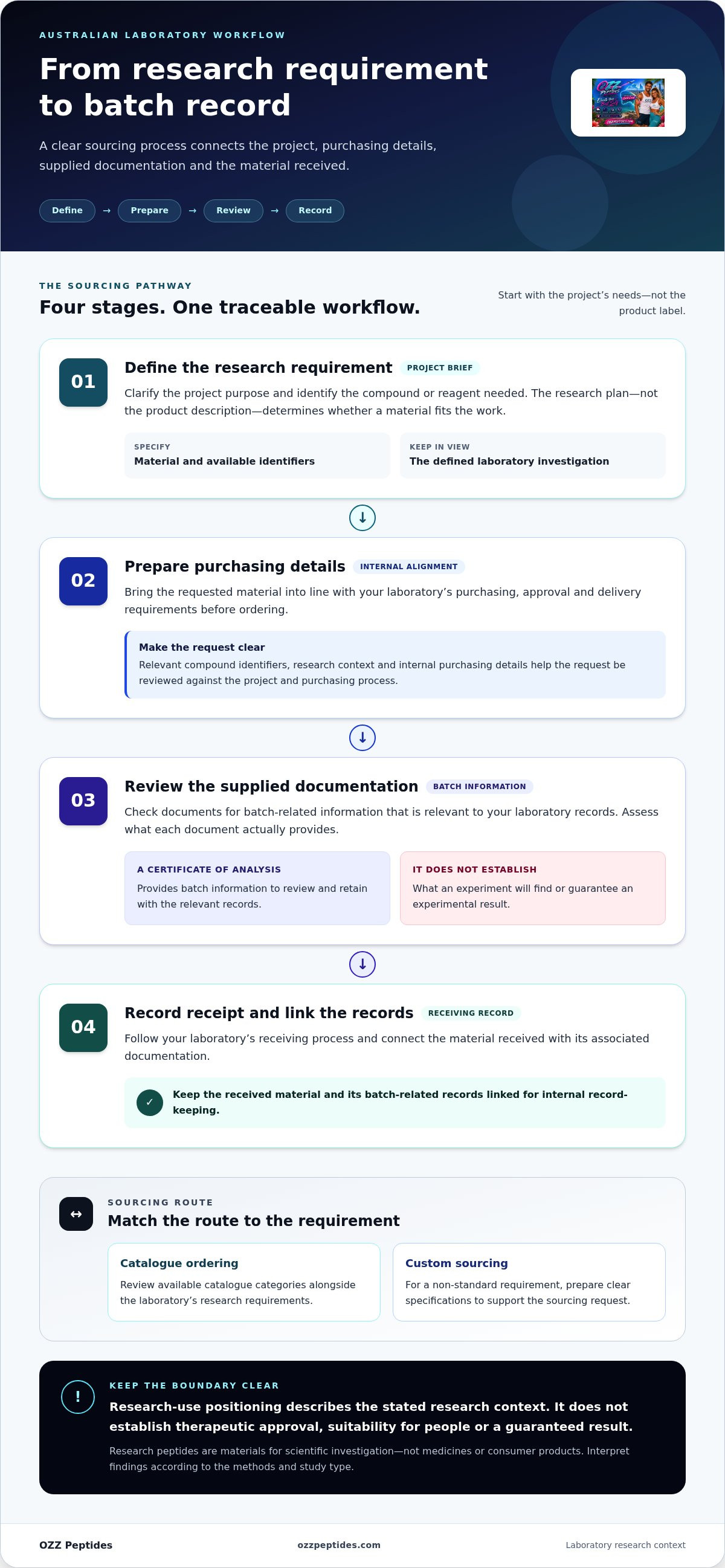
A simple procurement workflow helps connect the research requirement with the material received and the records kept. Australian labs sourcing research peptides can make the process easier to track with clear purchasing details and consistent batch records.
- Define the requirement. Record the project purpose and the compound or reagent needed, using the identifiers available to your team.
- Prepare purchasing details. Align the requested material with internal purchasing, approval and delivery requirements.
- Review documentation. Check the supplied documents for batch-related information relevant to your records.
- Record receipt. Follow your laboratory’s receiving process and connect the received material with its associated records.
What should researchers prepare before ordering?
Gather relevant compound identifiers, the research context and any internal purchasing details before placing an order. For a non-standard requirement, clear specifications help shape a custom sourcing request. Keep the description factual and focused on procurement: an unambiguous request is easier to review against the project and purchasing process than a broad description of the desired outcome.
How can a lab use batch documents in its records?
A Certificate of Analysis (COA) provides information associated with a particular batch. Match its identifiers with the received material and file it alongside the relevant purchase and receipt records, following your lab’s own procedures. OZZ Peptides provides access to batch-specific Certificate of Analysis information for its research-grade peptides.
A COA is a record to review, not a guarantee of experimental results or independent proof that a material suits every study. It doesn’t replace the project’s requirements or laboratory review. Keep the document’s scope clear, and record any relevant discrepancies through your established receiving process.
That’s a practical way to support traceability without overstating what batch paperwork can show.
Where can Australian labs source research peptides?
Australian labs can source research peptides through catalogue ordering or custom sourcing, depending on how clearly the project requirement is defined. OZZ Peptides supplies research peptides, reagents and laboratory compounds, with custom sourcing for non-standard compounds and reagents. Research-grade peptides are supported by third-party Certificates of Analysis, and secure online ordering and Australia-wide Express Post delivery are available.
When might a catalogue or custom sourcing route fit?
If your team has identified a specific research material, catalogue browsing gives you a direct way to review the research range against that requirement. Keep the relevant compound identifiers and purchasing needs to hand as you compare options.
For a non-standard compound or reagent, custom sourcing offers another route. Clear specifications help describe what the project requires. The sourcing request should reflect the research purpose and relevant purchasing details; it doesn’t guarantee a particular outcome or imply that a specific material is in stock. Both routes work best when the research requirement is well defined.
What is a useful next step for a research team?
Before ordering, bring together the project requirements, relevant compound identifiers and internal purchasing details. This gives your team a clear basis for comparing Australian sourcing options and organising procurement. A peptide research planning checklist can help structure the practical information your lab needs to consider.
OZZ Peptides is an Australian-owned supplier focused on scientific and laboratory research, with local customer support. Use the project requirements to guide your catalogue review or custom sourcing request, then follow your lab’s own purchasing and record-keeping procedures.
Make your next research decision easier
Turn the project’s current needs into a reusable sourcing brief. Record the purpose, preferred identifiers, internal approval pathway and who owns the procurement decision. Revisit the brief when the project scope changes, rather than relying on old assumptions. This gives research teams a practical starting point for future requests.
When assessing research peptides Australia sourcing options, consider whether the available information and purchasing pathway fit the defined laboratory purpose. This keeps decisions centred on research needs, not broad promises or expectations about outcomes. A short internal review before an order proceeds can help, especially when procurement and research responsibilities sit with different team members.
A named point person can coordinate questions across the team and help keep decisions consistent as the work progresses. Even a compact checklist can make choices easier to explain, compare and revisit. Build a process your team can use confidently as project requirements evolve.
A clear plan is a practical foundation for the next stage of your lab’s work. You’re well placed to move forward thoughtfully with OZZ Peptides.
Frequently Asked Questions
Can findings from animal studies be applied directly to people?
No. Animal results can help researchers decide what questions to investigate next, but they can’t establish how a peptide will affect people. Species differences, study conditions and the outcome being measured all matter. For example, observing a biological change in an animal model doesn’t show that the same change will occur in humans or have the same significance.
What does a Certificate of Analysis tell a research laboratory?
A Certificate of Analysis (COA) records information about a particular batch, according to the details provided in that document. A lab can use it alongside its purchasing and receipt records to help identify the material associated with a project. Check that the batch identifiers align, and retain the document through your normal records process. A COA doesn’t establish how the material will perform in an experiment.
Is research-use-only wording the same as medical approval?
No. “Research use only” wording isn’t medical approval, and a disclaimer alone doesn’t determine a product’s regulatory status in Australia. The Therapeutic Goods Administration has clarified that a product intended for therapeutic use may still be regulated as a therapeutic good despite such wording. Keep laboratory research separate from medical claims or personal use, and assess regulatory questions using current official Australian guidance.
How should a laboratory distinguish preliminary findings from established evidence?
Start by identifying the study stage: a cell experiment, an animal study or a human clinical trial. Then check what the researchers measured, how many participants or samples were involved, and whether other studies have reproduced the finding. A useful evidence note can record these details separately, so an early observation isn’t presented in reports or purchasing decisions as an established conclusion.
Can Australian researchers request help sourcing a non-standard compound?
Yes. OZZ Peptides offers custom sourcing to help Australian researchers source non-standard compounds and reagents. For a clear request, provide the compound identifier, relevant specifications and research context, along with any internal purchasing requirements. These details help define what the project needs. Custom sourcing is a procurement route for laboratory research, not a claim that a compound is a medicine or suitable for human use.
Disclaimer
Research Information Disclaimer
The information provided in this article is intended solely for general educational and scientific research purposes.
OZZ Peptides supplies laboratory research compounds and reagents for legitimate research applications only. Products labelled for research use are not intended for human or veterinary consumption, injection, diagnosis, treatment or prevention of disease.
Information about experimental compounds, scientific studies or preliminary research findings should not be interpreted as medical advice or evidence of regulatory approval.
Scientific findings may be preliminary, and research outcomes are not guaranteed.
Readers should consult appropriately qualified professionals and applicable Australian regulatory guidance before undertaking relevant research activities.