

Research peptide supplier

The easiest catalogue to order from isn’t always the best fit for your laboratory. A research peptide supplier should make it practical to assess product fit, batch documentation and sourcing support, not just browse a list of compounds. Clear evidence and straightforward ordering matter, especially when your requirements fall outside a standard catalogue.
It’s reasonable to find supplier claims hard to compare. Certificates of Analysis can vary in detail, and it’s important to see whether documentation relates to the specific item or batch you’re considering. This guide sets out consistent, evidence-led checks to help you compare suppliers and identify research compounds and reagents suited to your project.
We’ll look at documentation, product range, custom sourcing and Australian fulfilment, including what domestic ordering involves. OZZ Peptides is an Australian-owned supplier operating nationwide, featuring third-party Certificates of Analysis, custom sourcing support and Australia-wide Express Post. Products are supplied strictly for scientific and laboratory research purposes, not for human consumption or treatment.
Key Takeaways
- Compare a research peptide supplier across documentation, product fit, support and fulfilment, rather than relying on a single quality claim.
- Check that a Certificate of Analysis clearly relates to the product and batch you’re considering.
- Define your laboratory requirement before ordering so product selection or custom sourcing can be better aligned with the project.
- Review the ordering and delivery arrangements to understand how a supplier supports procurement through to receipt.
What should a research peptide supplier provide Australian laboratories?
Start with the project, not the product list. Your task is to source a research compound that matches a defined laboratory requirement, with relevant evidence and practical support behind the order. A suitable research peptide supplier should make it possible to assess documentation, product fit, communication and fulfilment together. One headline quality claim can’t answer all of those questions.
A research peptide supplier provides compounds and related support for scientific and laboratory research. That means research-use supply, not medicines or products intended for human consumption.
What does a research peptide supplier do?
A supplier provides research compounds and information that helps a laboratory identify what it is procuring. Peptides are a broad class of molecules; this overview of peptides offers useful background on their structure and classifications. The exact compound still needs to match the requirements of the project.
The supplier’s role is procurement support, not study design or interpretation. Researchers remain responsible for defining their research question, choosing appropriate methods and evaluating results. Understanding how scientific research peptides fit into laboratory work can also help clarify what information is relevant during procurement.
Which signals matter before comparing suppliers?
Look for identifiable product information and documentation that can be connected to the material supplied. A Certificate of Analysis (COA) is a document reporting analytical information about a product; check whether it identifies the relevant product and batch. OZZ Peptides provides Certificates of Analysis for research products.
- Product clarity: Check the compound’s name and available identifying details against your project requirements.
- Useful support: Consider whether ordering assistance can address routine procurement and non-standard compound or reagent needs.
- Evidence behind claims: Treat phrases such as “high quality” as a reason to inspect supporting evidence, not as proof on their own.
These checks create a more useful starting point than comparing a single metric. They help you judge whether the supplier’s information and service fit the work your laboratory needs to procure.
How to assess research peptide supplier documentation and quality claims
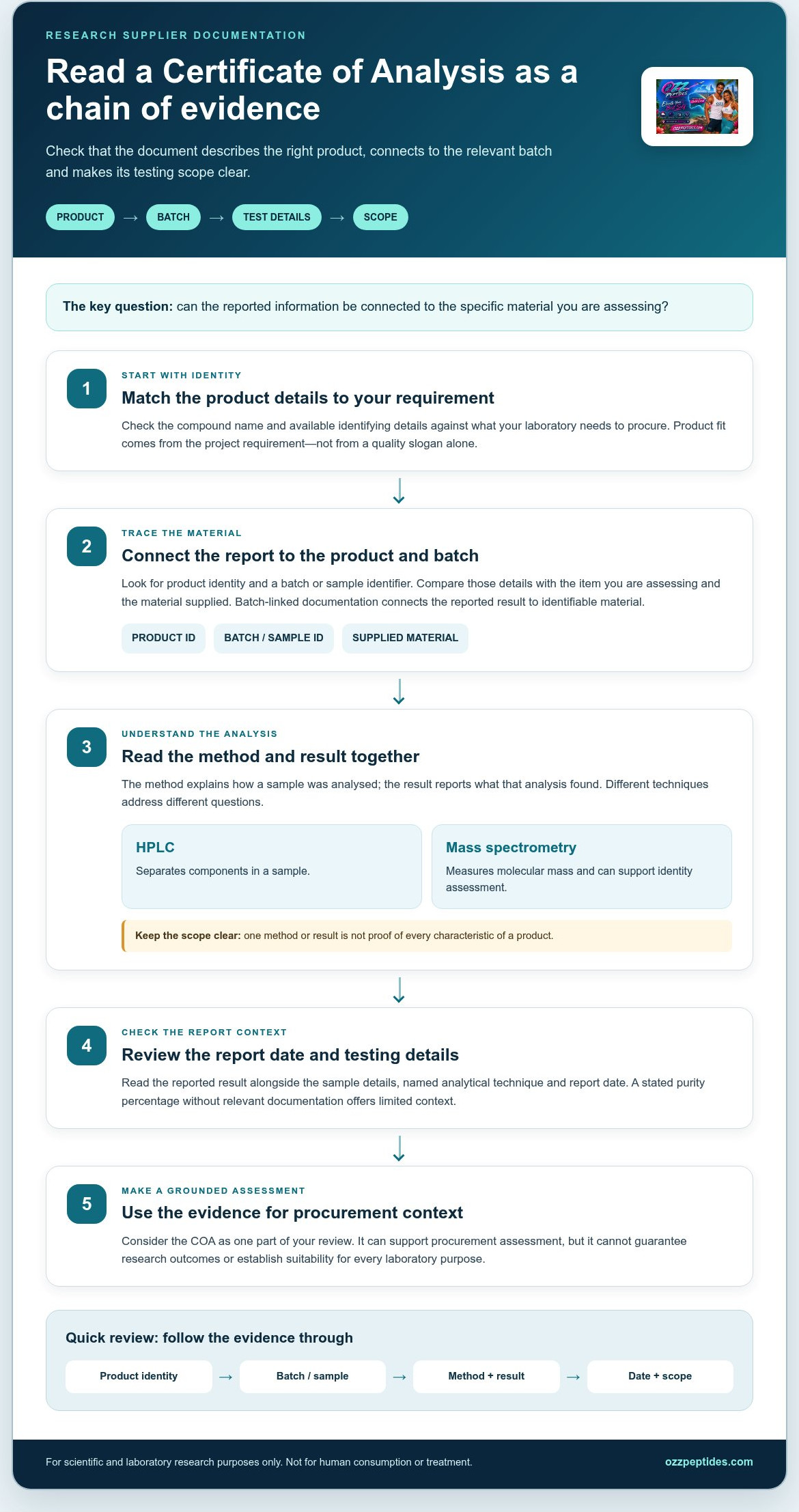
Review the paperwork as a chain of evidence: does it describe the right product, relate to the supplied batch and explain what was tested? A quality slogan or purity figure on its own doesn’t tell you whether the reported result applies to the material you’re procuring. Batch-linked documentation is more useful because it connects a stated result to identifiable material, rather than leaving the claim unsupported.
What can a Certificate of Analysis help you assess?
A Certificate of Analysis (COA) provides information about an analysed sample or batch. It can support your procurement review, but it can’t guarantee research outcomes or establish suitability for every laboratory purpose. Check the product identity, batch identifier, testing details and report date, then compare those details with the item and supplied material. The term “research-grade” should also be considered in context, rather than treated as a complete quality measure.
How should you interpret testing claims?
Read each claim in parts. The method describes how a sample was analysed; the result reports what that analysis found; the sample or batch identifier shows what the result applies to. HPLC separates components in a sample, while mass spectrometry measures molecular mass and can support identity assessment. They answer different analytical questions, so one method or result shouldn’t be treated as proof of everything about a product.
- Match: Compare the COA’s product and batch details with the material you’re assessing.
- Method: Note which analytical technique is named and what question it addresses.
- Scope: Read the reported result alongside its sample details and report date.
A stated purity percentage without relevant documentation offers limited context. Testing information also doesn’t establish suitability for human use or predict medical outcomes. Use these checks when reviewing research compounds in the catalogue, and keep procurement decisions tied to your laboratory’s defined requirements.
How to compare research peptide suppliers for your laboratory
A fair comparison starts with your laboratory’s requirements, not a supplier’s catalogue size or a single purity claim. Use the same practical criteria for each research peptide supplier, then weigh them against the compound or reagent your project actually needs.
Which supplier criteria belong in a fair comparison?
Compare the procurement details side by side. The aim is to see how clearly each supplier supports selection, ordering and receipt of laboratory research materials.
| Criterion | What to compare |
|---|---|
| Documentation | Is product information available, and can relevant documentation be linked to the supplied material? |
| Product fit | Does the listed compound or reagent match the project’s stated procurement requirements? |
| Support | Can customer care address product and ordering questions, including non-standard research needs? |
| Ordering | Is the process clear, including the information needed to place an order? |
| Delivery | Do the fulfilment arrangements suit the laboratory’s receiving process and required timeline? |
How do you match product range to research needs?
Begin with the compound or reagent specified by your research plan. Check the product information against that requirement before comparing the breadth of each catalogue. A larger range may offer more options, but it doesn’t automatically make a supplier the right fit for a particular procurement need.
If the item is part of a standard catalogue, assess how clearly it can be identified and ordered. If your requirement is non-standard, consider whether custom sourcing support can help address it. OZZ Peptides supplies research peptides, reagents and compounds, with custom sourcing support for non-standard requirements. Compare each supplier on what matters to your laboratory: relevant information, a suitable product match, useful support and fulfilment that fits your receiving arrangements. All comparisons should remain within scientific and laboratory research procurement.
How to prepare a research peptide order or custom sourcing request
A clear procurement brief helps match an order to your laboratory’s needs. Keep it focused on the item, documentation and receiving arrangements, not experimental protocols or product-use instructions. Whether selecting a catalogue item or making a non-standard request, prepare the key details before starting.
What information helps organise a sourcing request?
For a custom sourcing enquiry, describe the research requirement at a high level and identify the compound or reagent you’re seeking. Include any known product identifiers and documentation requirements. You can also outline the purchasing and delivery details your organisation needs to process and receive an order.
- Define the procurement need. Name the compound or reagent and briefly describe the laboratory research context.
- Identify the product. If you have a catalogue item or identifier in mind, include it. For non-standard requirements, state what you’re seeking as clearly as possible.
- Note documentation needs. Specify relevant records your purchasing process requires, such as a Certificate of Analysis.
- Prepare purchasing details. Include institutional purchasing information and the delivery address or receiving arrangements needed for the enquiry.
This sequence gives a research peptide supplier useful procurement context without sharing unnecessary experimental methods. OZZ Peptides offers custom sourcing support for non-standard research requirements, alongside secure online ordering for catalogue products.
How can Australian delivery fit laboratory procurement?
OZZ Peptides supports Australia-wide fulfilment through Express Post. Build delivery into your internal workflow: consider who can receive the parcel, where it should be sent and how your organisation handles purchasing approvals. Allow for your laboratory’s own receiving process rather than relying on an assumed delivery window. Clear details help keep the order aligned with your procurement steps.
With the requirement, product details, documentation needs and receiving arrangements organised, you’re better placed to proceed with a suitable research order.
Why consider OZZ Peptides as your Australian research peptide supplier?
A supplier should fit the way your laboratory manages purchasing, not just the item you need today. OZZ Peptides is Australian-owned and provides local customer care for researchers. That gives laboratories a domestic point of support when they have procurement questions or need help navigating the ordering process.
What support does OZZ Peptides provide Australian researchers?
Support is centred on laboratory research procurement. Clear communication can help purchasing teams coordinate product selection with their internal records and approval steps. This is particularly useful when different staff members handle supplier enquiries, purchasing and receipt. Keep the relevant product details and organisational requirements together so your team has a consistent reference throughout the process.
What is a practical next step for a research buyer?
Before placing an online order, align the item you’re considering with your laboratory’s purchasing requirements. Make sure the person responsible for receiving the order has the information they need, and keep procurement records accessible to colleagues who may manage future purchases. A clear internal handover can make the process easier to follow from selection through receipt.
Explore the available research products and identify the options that fit your laboratory’s procurement needs.
For a straightforward next step, browse the catalogue and take your laboratory’s requirements into account as you select products for research use.
Keep your next research purchase aligned with the work ahead
As your laboratory’s research programme develops, keep procurement aligned with planned work and your team’s processes. A clear internal record of requirements can help colleagues maintain continuity across future orders, especially when projects involve different compounds or purchasing approvals.
Choosing a research peptide supplier isn’t a one-off box-ticking exercise. Keep the decision grounded in research purpose and your laboratory’s practical procurement priorities. Before placing an order, take a moment to align the purchase with your organisation’s approval and receiving steps. That small habit can make future sourcing decisions easier to manage across a team.
Explore the research range when you’re ready to take the next step.
A considered approach gives your laboratory a solid base for the work ahead. Start with the requirements that matter to your project and move forward with confidence.
Frequently Asked Questions
What should a research peptide supplier provide with an order?
A supplier should provide clear product identification and relevant supporting documentation, such as a Certificate of Analysis where available for the product. Check that the paperwork is accessible and that the order information lets your team match what arrives to the item purchased. Your organisation may also need an order record, delivery details or purchasing documentation for its internal procurement process.
How can I tell whether a peptide Certificate of Analysis is relevant to my order?
Compare the Certificate of Analysis with the product you ordered, paying particular attention to the compound name and any batch identifier shown on the document. For example, a report that names a different product or refers to a different batch may not support your review of the material received. Keep the document with your procurement record so colleagues can trace it later.
Are research peptides medicines or products for human use?
No. OZZ Peptides supplies research peptides for scientific and laboratory research purposes only. They are not medicines, medical treatments or products for human consumption. A product’s research documentation does not make it suitable for personal use or establish a health benefit. Keep purchasing, handling and any laboratory work within your institution’s applicable research procedures and safety controls.
Can an Australian supplier source a non-standard research compound?
Yes. OZZ Peptides offers custom research product sourcing to help laboratories seek non-standard compounds and reagents. A useful enquiry identifies the compound or reagent, gives any known product identifiers and outlines the procurement requirement. This provides a practical starting point for a sourcing request, without assuming that every requested item can be supplied or setting an unconfirmed fulfilment timeframe.
How are research peptides delivered across Australia?
OZZ Peptides fulfils Australian orders through Express Post. Before ordering, consider how your laboratory receives parcels, including the correct delivery address and who can accept the shipment. If your organisation routes purchases through a central stores team, factor that internal handover into your procurement planning. No specific delivery window should be assumed unless it is stated during the ordering process.
What information should a laboratory prepare before placing a research peptide order?
Prepare the product name or identifier, your organisation’s purchasing details and the delivery information needed for receipt. It can also help to note any documentation your procurement team requires and who will review the order internally. For example, a central purchasing office may need a supplier record or supporting product paperwork before approving a purchase. Keep the request focused on procurement, not experimental instructions.
Can OZZ Peptides help source laboratory reagents as well as peptides?
Yes. OZZ Peptides supplies laboratory research reagents as well as peptides and other research compounds. Custom sourcing support can help laboratories seek reagents beyond standard catalogue requirements. For a clear enquiry, identify the reagent and include any known product reference or purchasing documentation needs. All products are intended for scientific and laboratory research, not human or veterinary use.
Disclaimer
Research Information Disclaimer
The information provided in this article is intended solely for general educational and scientific research purposes.
OZZ Peptides supplies laboratory research compounds and reagents for legitimate research applications only. Products labelled for research use are not intended for human or veterinary consumption, injection, diagnosis, treatment or prevention of disease.
Information about experimental compounds, scientific studies or preliminary research findings should not be interpreted as medical advice or evidence of regulatory approval.
Scientific findings may be preliminary, and research outcomes are not guaranteed.
Readers should consult appropriately qualified professionals and applicable Australian regulatory guidance before undertaking relevant research activities.