

Research Reagents for Australian Laboratories

Could a familiar reagent label still point you towards the wrong choice for your experiment? Research reagents can trigger, detect or measure reactions, or support a laboratory process, but the label alone doesn’t tell you whether one suits your workflow. This guide to research reagents Australia explains how to assess fit before comparing options.
It’s easy to get stuck on unfamiliar category names or product listings that leave key details unclear. The useful starting point is your research question: what the reagent needs to do, which method you’ll use and what evidence or documentation your work requires.
Here, you’ll find a practical way to compare reagent types, check relevant specifications and interpret quality documents without relying on broad catalogue claims. We’ll also cover Australian sourcing considerations and explain how to distinguish research-use laboratory materials from products intended for human use. OZZ Peptides supplies research reagents and laboratory research compounds across Australia, with custom sourcing for non-standard research needs. The aim is simple: help you make a clearer, research-led choice for your project.
Key Takeaways
- Start with the research task and analytical method, not just the reagent’s catalogue category.
- Use workflow examples, such as immunoassay and molecular biology, to narrow down relevant reagent types.
- For research reagents Australia, compare protocol requirements with product documentation before selecting a reagent.
- Explore catalogue options or custom sourcing for non-standard laboratory research compounds and reagents.
Research reagents Australia: their role in the lab
A reagent is a material used to support or enable a laboratory procedure. It may take part in a reaction, help detect a target or be used to prepare a sample. Its role depends on the experiment, the protocol and the analytical method, so a broad label alone won’t tell you whether it suits a particular task.
Clear product descriptions help researchers understand a reagent’s stated laboratory context before comparing options. The broader term What are research chemicals? offers background on research chemicals, but product documentation helps clarify an individual product’s stated purpose. OZZ Peptides’ research information for Australia also provides preparation and handling context to consider alongside the relevant protocol and product-specific guidance.
How is a reagent different from a compound or laboratory supply?
These terms describe different things. A compound describes a chemical substance; a reagent describes a material by its role in a procedure. The same substance may be described as a compound and used as a reagent, depending on the context. For example, assay materials support a measurement procedure, while molecular biology reagents may be used in DNA- or RNA-related workflows.
A laboratory supply is a broader grouping that can include materials used in research. Equipment, such as an instrument, performs or supports a task; consumables, such as sample tubes, hold or handle materials. None of these labels guarantees a product is suitable for a specific experiment. Its description and research documentation help define the intended context.
Why does reagent fit matter to a research project?
Reagent choice should line up with the research question, the material being analysed and the steps in the protocol. A category name like “assay reagent” doesn’t establish compatibility with every assay or sample type. Check how the product is described against the method you plan to use, then follow the protocol and product-specific handling guidance. That simple comparison helps keep the choice grounded in the actual research task.
Which research reagent categories support different laboratory workflows?
Reagent categories can help you narrow a search, but they’re most useful when connected to a specific research task. The examples below cover common workflows; they’re illustrative, not a complete catalogue. Australian research spans diverse fields, including work at Australia’s National Science Agency, so project requirements can vary widely.
The same reagent category can support different workflows, because its role depends on the protocol, sample and question being investigated.
| Workflow | Example reagent category | Research task it may support |
|---|---|---|
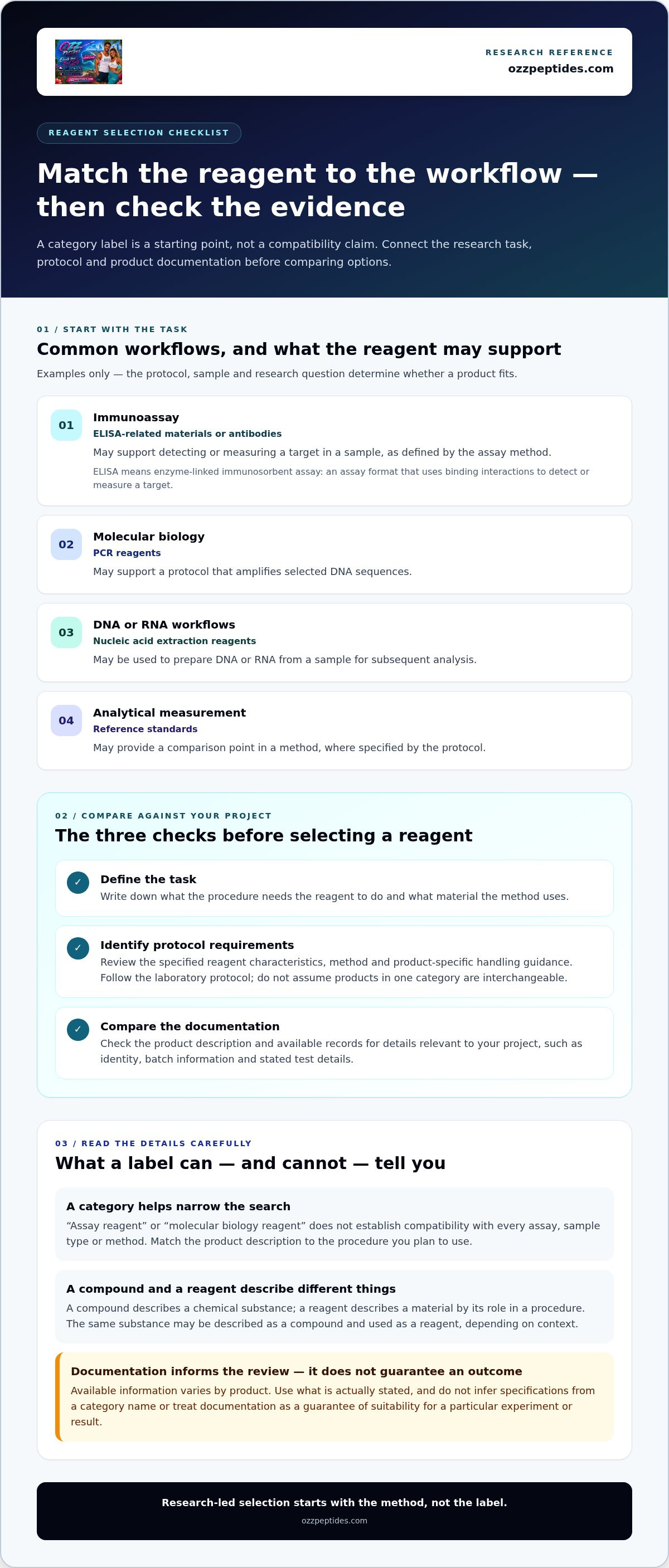
| Immunoassay | ELISA-related materials or antibodies | Detecting or measuring a target in a sample, as defined by the assay method. |
| Molecular biology | PCR reagents | Supporting a protocol that amplifies selected DNA sequences. |
| DNA/RNA workflows | Nucleic acid extraction reagents | Preparing DNA or RNA from a sample for subsequent analysis. |
| Analytical measurement | Reference standards | Providing a comparison point in a method, where specified by the protocol. |
What are examples of assay and molecular biology reagents?
ELISA, short for enzyme-linked immunosorbent assay, is an assay format that uses binding interactions to detect or measure a target. Antibodies may be used in assay research, depending on the method. In molecular biology, PCR reagents support DNA amplification, while other reagents may be used in DNA or RNA preparation. These are examples of research categories, not guarantees of suitability or a complete list of products.
How should researchers interpret category labels?
Think of a label as a starting point, not a compatibility claim. Application, sample type and analytical method can all affect whether a reagent fits a protocol. Compare the product description with the procedure’s requirements before selecting it. For labs exploring research reagents Australia-wide, OZZ Peptides’ research products provide one place to browse relevant laboratory research categories.
How can Australian researchers assess a reagent for a project?
Use a simple sequence: define the research task, identify the protocol requirements, then compare the product description and available documentation. This keeps the choice tied to the experiment rather than a broad label. For research reagents Australia-wide, the same checks help make product details easier to assess across different project needs.
- Define the task. Note what the procedure needs the reagent to do and what material the method uses.
- Identify protocol requirements. Review the specified reagent characteristics, method and product-specific handling guidance. Follow the laboratory protocol rather than assuming products in one category are interchangeable.
- Compare documentation. Review the product description and available records for details such as identity, batch information and stated test details. Compare these with the project’s requirements.
What should researchers check before selecting a reagent?
Match the description to the intended method and sample, then check that the available documentation provides details relevant to your review. The information will vary by product, so focus on what is actually stated rather than inferring a specification from the category name. Documentation can inform a decision, but it can’t guarantee suitability for a particular experiment or a specific result.
How do documentation and research guidance support informed use?
Product records can support review and traceability, while experimental controls remain essential for interpreting results. For relevant research-grade peptide products, OZZ Peptides provides independent third-party Certificates of Analysis. These documents relate to the applicable peptide product, not automatically to every reagent or compound. You can review available Certificates of Analysis and use the research reconstitution guidance alongside the product’s own instructions and laboratory protocol.
Australian research is supported across disciplines by bodies such as the Australian Research Council. Whatever the project, keep handling and use within the product guidance and approved laboratory research protocol.
Where can Australian labs source research reagents and related support?
Australian labs can source research reagents and laboratory compounds through suppliers that serve research customers nationally. OZZ Peptides offers secure online ordering and Australia-wide Express Post, with local customer care for Australian researchers. These options can help teams manage procurement through one domestic channel while keeping their own project requirements and laboratory processes in view.
How can labs plan research procurement?
Build purchasing into the project plan rather than leaving it until a reagent is needed at the bench. Coordinate orders with the laboratory’s internal purchasing process and the relevant research milestones. Keep product details and order records together with project documentation so the team can track procurement decisions. This practical preparation helps researchers organise sourcing without assuming a particular delivery timeframe.
What can researchers expect from an Australian supplier?
A national supplier can provide a consistent point of access for research teams across Australia. OZZ Peptides supports customers through secure online ordering, Australia-wide dispatch via Express Post and local customer care. These are useful sourcing considerations for laboratories coordinating research procurement across locations or teams. Product selection and handling should still follow the laboratory’s research protocol and the guidance supplied for the relevant product.
For laboratory research use only, browse the available research reagents and compounds to find options relevant to your work.
Turn your research requirements into a clear next step
Before your next order, put the project’s key requirements into a short procurement brief. Note the research purpose, the method and any essential product documentation. This gives your team a shared reference point and makes it easier to compare options without losing sight of what the experiment actually needs.
Sourcing research reagents Australia-wide can involve distinct project requirements, so keep the brief specific to your laboratory work. If a standard catalogue option doesn’t match the project, custom sourcing offers another pathway for non-standard research compounds or reagents. Keep all product selection and handling within the relevant research protocol and product guidance.
Clear requirements make the next decision more manageable. Take the time to identify what your work needs, then explore the available research products at your own pace.
Good research starts with a considered choice. Here’s to your next project moving forward with confidence.
Frequently Asked Questions
What is the difference between a research reagent and a laboratory consumable?
A reagent is identified by its role in a procedure, while a consumable is generally a supply used during laboratory work; an item can fit both descriptions. For practical inventory records, note how the item is used, how it’s ordered and whether its identity needs batch-level tracking. That makes purchasing and stock records more useful than relying on a category label alone.
Can the same research reagent be used in different experiments?
Sometimes, if the receiving method has been assessed for that reagent. Before transferring it to another workflow, document relevant changes to preparation, instrument settings and acceptance criteria. Record the basis for adopting it and the outcome of the method’s validation checks. This creates a traceable rationale for the change. Matching ingredient names alone don’t establish equivalent performance across experiments.
What does a Certificate of Analysis tell a researcher?
A Certificate of Analysis reports product or batch information, but it isn’t a safety data sheet. The latter provides hazard and handling information, so don’t use one document as a substitute for the other. Keep the applicable records with the project’s purchasing and laboratory files, using clear file names that identify the material and batch. This makes later document retrieval more straightforward.
Can research reagents be used for human consumption or treatment?
No. Research reagents are intended for scientific and laboratory research, not human consumption or treatment. A research-use label, laboratory record or experimental finding doesn’t establish that a substance is safe or appropriate for people. Keep the material and its records within the research setting, and follow your organisation’s policies for laboratory work. OZZ Peptides doesn’t provide medical consultations, treatment plans or personal dosing advice.
How should a laboratory decide whether a reagent is suitable?
Assess suitability by documenting the decision against the project’s requirements, then recording the chosen material and rationale in the research file. Include the method version, product identifier and any criteria the team uses to accept or reject the material. A concise decision record helps colleagues understand why it was selected and review that choice if the method or project changes.
Disclaimer
Research Information Disclaimer
The information provided in this article is intended solely for general educational and scientific research purposes.
OZZ Peptides supplies laboratory research compounds and reagents for legitimate research applications only. Products labelled for research use are not intended for human or veterinary consumption, injection, diagnosis, treatment or prevention of disease.
Information about experimental compounds, scientific studies or preliminary research findings should not be interpreted as medical advice or evidence of regulatory approval.
Scientific findings may be preliminary, and research outcomes are not guaranteed.
Readers should consult appropriately qualified professionals and applicable Australian regulatory guidance before undertaking relevant research activities.