

Third-Party Testing: What Research Buyers Should Check

What if a peptide’s impressive purity percentage tells you less than you think? For third party tested research peptides, a number alone doesn’t show whether the test confirms identity, which batch was analysed or who performed the analysis. It’s understandable to want a clear result, especially when supplier claims and reports can be hard to compare.
This guide explains what independent testing can tell you, and where its limits are. You’ll learn how to read a Certificate of Analysis, connect it to a specific batch and understand the different roles of methods such as HPLC and mass spectrometry. You’ll also see why a test result isn’t proof of safety, therapeutic effect or suitability for human use. OZZ Peptides supplies research compounds for scientific research only, not human consumption or injection. We’ll keep the checks practical, so you can assess the evidence behind a research peptide with greater confidence.
Key Takeaways
- Assess third party tested research peptides by looking beyond a headline purity figure and checking what the reported method actually measures.
- Use HPLC and mass spectrometry results for different purposes; neither result alone describes every quality attribute.
- Compare reports systematically by checking the sample details, test method, analysis date and link to the relevant batch.
- Use accessible product documentation to make a more informed research purchasing decision, while keeping laboratory research separate from human use.
What does third-party testing mean for research peptides?
Third-party testing is analysis of a sample by a laboratory independent of the supplier, with results reported for the tests performed. That definition describes who carried out the analysis, not a certification or a guarantee of overall quality. The report’s method, sample details and stated results show what the evidence can support.
A supplier statement such as “independently tested” is a claim about testing. A laboratory report gives readers more detail to assess, but independence alone doesn’t establish what was measured or how. For example, Liquid Chromatography-Mass Spectrometry (LC-MS) combines separation with mass analysis, but a report still needs to identify the method and results for its particular sample.
How is independent testing different from a supplier claim?
A supplier claim may tell you that testing occurred. An independent laboratory report can add traceable details, such as the laboratory name, sample description, test method and findings. Read those details rather than treating the word “independent” as the result itself. A report’s scope matters: it only supports conclusions that follow from the analysis actually performed.
Why does batch-specific documentation matter?
A batch identifier links a report to a defined quantity of material. Compare the identifier on the report with the batch information for the product under consideration. If they don’t match, the report may not document that material. A report for one batch also doesn’t automatically apply to later batches; each needs its own supporting documentation.
For research purchasing, this makes the Certificate of Analysis (CoA) a useful starting point, not a complete verdict. Check that the document identifies the sample and batch, and read its methods and results in context. OZZ Peptides provides third-party CoAs where supported by product documentation, available through its Certificates of Analysis page. Research compounds are supplied for scientific research only, not human consumption or injection.
What can HPLC and mass spectrometry tell you about a peptide?
HPLC and mass spectrometry answer different analytical questions. High-performance liquid chromatography (HPLC) separates components in a sample, while mass spectrometry analyses the mass-to-charge patterns of detected ions. Used together, they can provide complementary information, but the report’s method and sample details matter. A purity percentage is a reported result under particular test conditions, not a complete quality assessment.
What does an HPLC result show?
HPLC separates compounds as they pass through a column. A detector records peaks on a chromatogram, and the relative peak areas may be used to estimate chromatographic purity. That estimate depends on the method and what the detector can register. A high percentage alone doesn’t confirm molecular identity, sterility or suitability for a particular research protocol.
What does mass spectrometry add?
Mass spectrometry measures the mass-to-charge ratio of ions, which can support an assessment of whether the detected material’s molecular mass is consistent with the expected compound. It doesn’t, by itself, establish every feature of a sample or rule out all impurities. Healthy Male’s overview of peptides in Australia also provides useful context on the distinction between research compounds and therapeutic use.
A purity result describes what a specified method detected in a tested sample; it doesn’t, on its own, establish the sample’s complete identity, safety or suitability. For third party tested research peptides, read the reported method alongside the sample and batch details. Look for the method name, result units and chromatogram or supporting analytical data, where provided. Don’t treat a percentage as a universal measure that makes results from different methods directly comparable.
Use those distinctions when reviewing research compounds and their documentation. OZZ Peptides’ research peptide catalogue offers a practical place to consider research-use products alongside the documentation provided for them. All compounds are for scientific research only, not human consumption or injection.
How can you compare third-party tested research peptides?
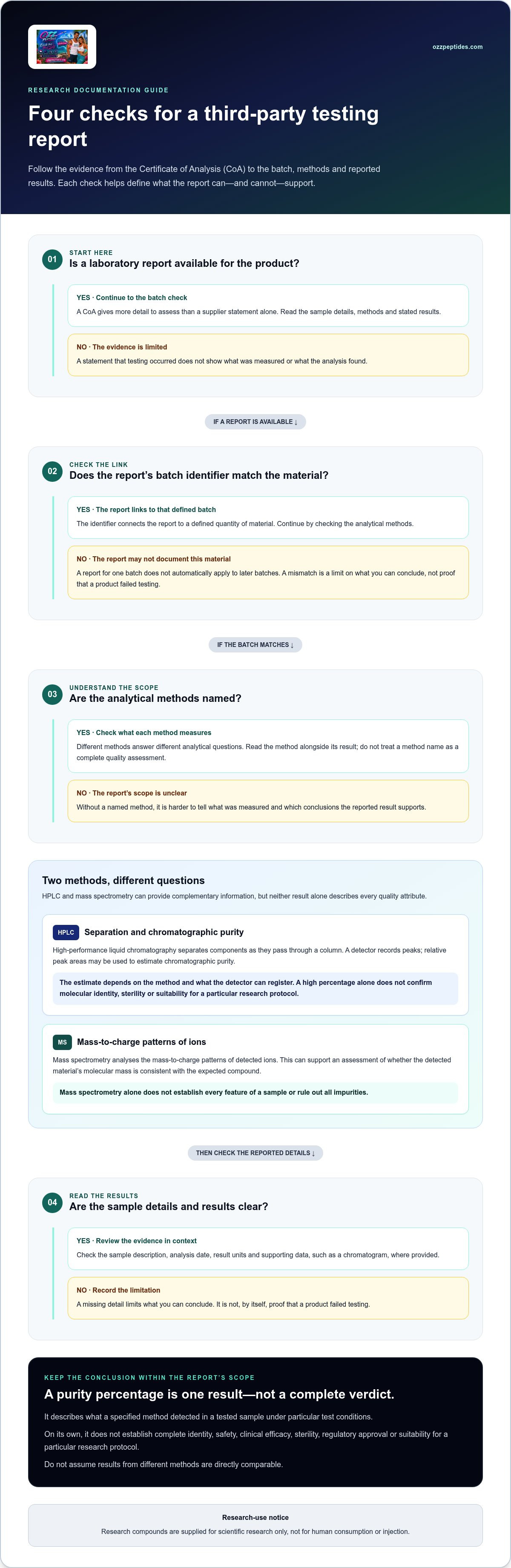
Use the same checks for each report, so supplier claims are easier to compare on a like-for-like basis. A missing detail limits what you can conclude; it isn’t, by itself, proof that a product has failed testing.
- Locate the report. Find the Certificate of Analysis (CoA) connected to the product, rather than relying only on a testing statement.
- Match the batch. Compare the report’s batch identifier with the material you’re assessing. Don’t assume an older report covers a later batch.
- Identify the methods. Note which analytical methods were used and what each one measures.
- Read the stated results. Check the sample description, analysis date, result units and any supporting data, such as a chromatogram.
Which details make a report easier to assess?
A useful report makes its evidence traceable. Look for a clear sample name, a batch identifier, the analysis date, named methods and legible results. If a method or result is missing, record that limitation rather than filling the gap with an assumption. OZZ Peptides’ Certificates of Analysis page provides access to documentation where product records support it.
What should a test report not be used to claim?
Keep conclusions within the report’s scope. A purity result isn’t evidence of clinical efficacy or human safety. Nor does it establish sterility, regulatory approval or suitability for a particular research protocol unless the relevant evidence specifically supports those claims. For third party tested research peptides, the report helps assess the analyses performed, not every possible quality or use question.
Research compounds are for scientific research only, not human consumption or injection. Use report details to make a more informed comparison, then consider research products with documentation that supports your assessment.
Where can Australian researchers find documented research peptides?
Before selecting a research compound, use the evidence checklist consistently: find the report, match its batch to the material, identify the methods and read the results within their stated scope. A clearly presented purity figure can be useful, but it shouldn’t replace these checks. Keep the distinction between what a report records and what it doesn’t establish in view.
How does OZZ Peptides support an informed research purchase?
OZZ Peptides is Australian-owned and operated, supplying research-grade peptides and laboratory compounds to researchers nationally. Third-party Certificates of Analysis are available where supported by product documentation, so review the documentation for the relevant product rather than assuming every compound or batch has identical testing. The Certificates of Analysis page provides a place to access available reports and consider their details alongside your research requirements.
For third party tested research peptides, check that the document relates to the material you’re considering. Note the sample description, batch identifier, analysis date, named method and reported results. If details are absent, limit your conclusions to what the report actually shows. Missing context isn’t proof of a failed product, but it does leave questions the document can’t answer. A guide to research peptide purity and documentation can also help keep method claims and result interpretation in perspective.
What is a sensible next step?
Review relevant product documentation before making a research selection. Compare the report’s scope with the requirements of your planned laboratory work, and don’t infer human safety, treatment effects or protocol suitability from analytical results. OZZ Peptides’ research compounds are supplied for scientific research only, not for human consumption, injection or treatment.
Build stronger decisions into your next research project
Make documentation part of your research planning, not just a purchasing check. Keep the relevant report with your project records and note how its scope relates to the material selected. This gives your team a clearer starting point when reviewing results, comparing materials or documenting decisions later.
Third party tested research peptides can provide useful analytical evidence, but sound research decisions also depend on a well-defined question, appropriate methods and careful interpretation of findings. Keep those elements distinct. A test report informs your assessment of a sample; it doesn’t replace the reasoning behind your research design.
When you’re ready to consider research compounds, use the available product information to guide your next step and keep your selection aligned with your laboratory work.
Explore Our Research Range
Clear records and thoughtful choices help set up research on a more confident footing.
Frequently Asked Questions
Does HPLC purity prove a research peptide is safe or effective?
No. An HPLC purity estimate doesn’t establish a clinical outcome. Evidence for an effect must relate to the compound and question being studied, and laboratory observations, animal findings and human clinical trial results represent different levels of evidence. A chromatogram can’t replace appropriate assessments of safety or sterility. Use the result for its stated analytical purpose, not as a measure of treatment benefit.
Can mass spectrometry confirm a peptide’s identity?
Mass spectrometry can support an identity assessment by comparing measured mass information with an expected value. The interpretation depends on the analysis described in the report. A compatible mass result alone may not resolve every structural or sample-composition question. Check how the report presents the method and findings, and avoid treating one matching result as an absolute guarantee of identity.
What should I check on a third-party peptide Certificate of Analysis?
Confirm that the document describes the material you’re assessing, then save the exact report used in your research records. Keeping that copy helps your team track which document informed a selection, particularly if online records are updated later. OZZ Peptides’ Certificates of Analysis page provides access to available documentation, which you can compare with the product and batch details in your records.
Does third-party testing mean research peptides are approved for human use?
No. A laboratory report presents analytical findings; it doesn’t establish authorisation for therapeutic use. OZZ Peptides’ compounds are supplied for scientific and laboratory research only, not human consumption, injection or treatment. Keep these questions separate: use the report to understand its stated results, and consult current Therapeutic Goods Administration information for Australian regulatory status rather than inferring approval from a purity or identity result.
Disclaimer
Research Information Disclaimer
The information provided in this article is intended solely for general educational and scientific research purposes.
OZZ Peptides supplies laboratory research compounds and reagents for legitimate research applications only. Products labelled for research use are not intended for human or veterinary consumption, injection, diagnosis, treatment or prevention of disease.
Information about experimental compounds, scientific studies or preliminary research findings should not be interpreted as medical advice or evidence of regulatory approval.
Scientific findings may be preliminary, and research outcomes are not guaranteed.
Readers should consult appropriately qualified professionals and applicable Australian regulatory guidance before undertaking relevant research activities.